 info@allaroundtexasroofing.com
 Schedule Now
 (469) 598-0899
No, not in the sense most people mean. Shingles should not be installed over a wet deck, and a responsible crew will not strip a roof with rain on the radar. But rain arriving partway through a replacement is not a disaster either, and on a well-run job in McKinney, Frisco, or anywhere else in North Texas, it is planned for from the first morning.
TL;DR
A roof should not be replaced while it is actively raining. The deck and underlayment need to be dry before shingles go on; the residential code requires shingles to be applied according to the manufacturer’s instructions, and a wet roof is a genuine fall hazard for the crew. What a good contractor does instead is watch the forecast, tear off only as much roof as can be dried in the same day, and keep tarps and underlayment ready. If rain arrives unexpectedly, exposed sections are covered, the crew comes down, and work resumes once the deck is dry. In the Dallas and Fort Worth area, May and October are the wettest months on the 30-year normals, so those are the months when rain delays are most likely. Ask any roofer how they handle a surprise storm before you sign.
Why Shingles and Rain Do Not Mix
Three separate problems show up when water meets a roof that is being replaced.
The first is the deck. Plywood and OSB sheathing absorb water. A deck that is wet when it gets covered stays wet longer, and trapped moisture under new underlayment is how a brand-new roof starts its life with soft spots and odor in the attic.
The second is the shingle itself. Asphalt shingles hold each other down with a strip of sealant that bonds in warm, dry conditions. ASTM’s own standard for testing shingle wind resistance lists temperature, time, and dirt and debris among the factors that affect how shingles seal in the field. Water on the surface is one more thing between the sealant and the shingle above it.
The third is the instructions. Section R905.1 of the 2024 International Residential Code says roof coverings “shall be applied in accordance with the applicable provisions of this section and the manufacturer’s installation instructions”. Those instructions are printed on or with every bundle. We have not seen a set that tells a roofer to apply shingles over a wet deck.
What Happens if It Rains Halfway Through?
If it rains halfway through a roof replacement, a well-organized crew stops tearing off, covers every exposed section with underlayment or tarps, fastens the cover so wind cannot lift it, and comes down off the roof. Work resumes once the rain has passed and the deck has been checked and is dry.
The key is how much roof is open at any one time. A well-run crew tears off in sections sized so each one can be dried in the same day. By the end of every working day, each stripped section should have underlayment on it at minimum, whether or not shingles have gone down yet.
Here is how that plays out on a typical job.
| When the rain arrives | What is exposed | What the crew does |
|---|---|---|
| Before tear-off starts | Nothing | Delays the start. The old roof is still keeping you dry |
| During tear-off | Bare deck on one section | Stops stripping, lays underlayment or tarps over the open deck, secures it |
| After underlayment, before shingles | Underlayment only | Checks laps and fastening, covers vulnerable edges, waits |
| During shingling | A partly shingled section | Stops, covers the unfinished edge so water cannot run under it |
| After the job | Nothing | Nothing. The roof is finished |
Why underlayment buys time but is not a roof
Underlayment is designed to sit under shingles as a second line of defense. It will shed a passing shower for a day or two when properly fastened, which is exactly why it goes down first. Underlayment was never meant to stand alone for weeks. A crew that leaves a roof in underlayment for a long stretch is taking a risk with your house.
Who Pays if Water Gets In During the Tear-Off?
In most cases, the contractor does. If water enters your home because a crew left a section of roof uncovered, that is damage caused by the work, and it is the roofing company’s responsibility and its insurance to put right.
So before signing, skip “will you work in the rain?” and ask “what is your plan if it rains while my roof is open, and who pays if something goes wrong?” A confident, specific answer is a good sign. A vague one is not.
A few more questions worth asking:
- How many squares will you tear off at once?
- Do you keep tarps on site every day?
- Who watches the weather, and when do you decide to start?
- Is the company insured for damage to the home during work?
- How will you document any water that gets in?
Our guide to choosing a roofing contractor in North Texas covers the rest of the vetting.
The Safety Side Nobody Mentions
A wet roof is slippery, and a roof covered in torn shingle debris and loose granules is worse. That matters to you as the homeowner even though it is the crew’s problem, because a contractor who works through rain is showing you how they treat risk.
Federal rules are clear about height. OSHA’s fall protection standard, at 29 CFR 1926.501(b)(13), requires workers in residential construction 6 feet or more above a lower level to be protected by guardrails, safety nets, or personal fall arrest systems, unless the employer can show those are infeasible and follows a written fall protection plan instead.
Rain leaves that rule exactly as it is and raises the cost of ignoring it.
Which Months Bring the Most Rain Delays in North Texas?
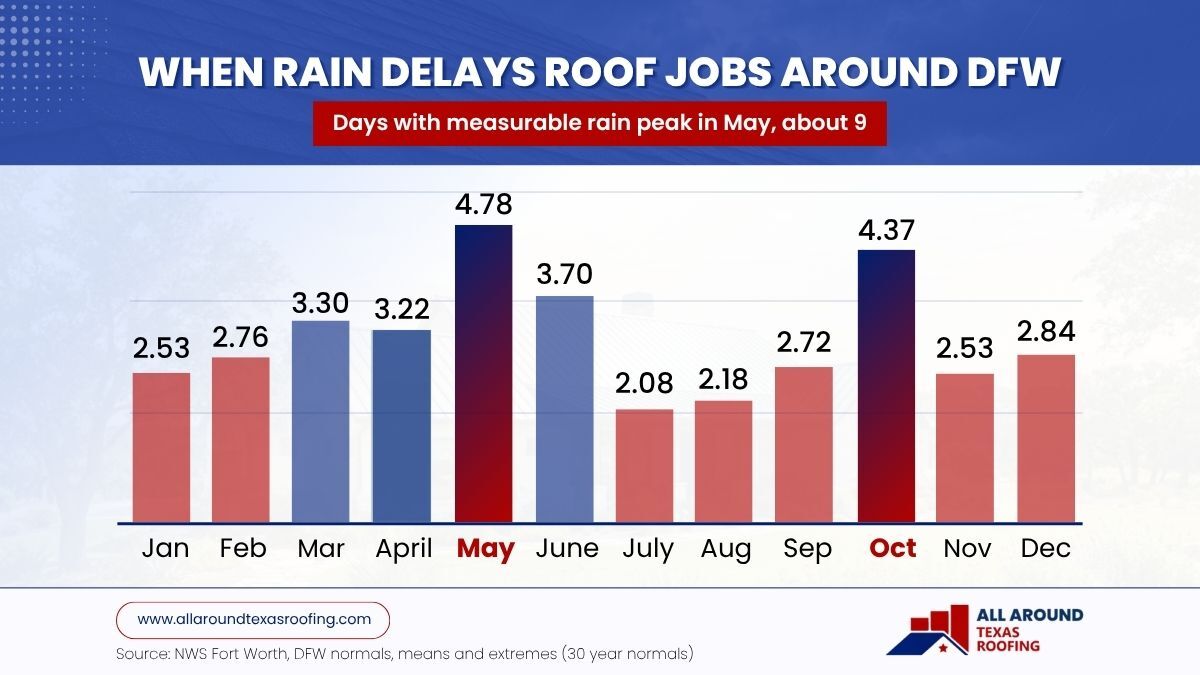
In the Dallas and Fort Worth area, May and October bring the most rain delays. On the National Weather Service’s 30 year normals for DFW Airport, May averages 4.78 inches of rain across about 9 days with measurable rain, and October averages 4.37 inches across about 7 days. July and August are the driest months, with about 2 inches each.
The NWS Fort Worth office’s normals for DFW put the whole year in one place.
| Month | Normal rain (inches) | Days with measurable rain |
|---|---|---|
| January | 2.53 | 6.9 |
| February | 2.76 | 6.9 |
| March | 3.30 | 7.8 |
| April | 3.22 | 6.9 |
| May | 4.78 | 9.1 |
| June | 3.70 | 7.2 |
| July | 2.08 | 4.4 |
| August | 2.18 | 5.2 |
| September | 2.72 | 5.1 |
| October | 4.37 | 7.1 |
| November | 2.53 | 6.2 |
| December | 2.84 | 6.5 |
The office’s own climate narrative for the area describes the pattern as wet spring and fall with drier summer and winter, and notes that most of the rain in those wet seasons arrives with thunderstorms rather than long soaking days. That is the practical point for a roof. Thunderstorm rain tends to come and go, so a crew that watches the radar closely and dries in each section promptly can often work in the gaps.
The catch with the dry months
July and August have the least rain and the most heat. Shingles become soft and easy to scuff in extreme heat, and crews working in the high 90s need early starts. Dry does not always mean easy.
Rain Delays After a Big Hailstorm
The worst time to be waiting on a roof is after a large hailstorm, and it is worth knowing why before it happens to you.
Spring hail in Collin County tends to arrive in the same weeks as the spring rains. A storm that damages several thousand roofs across McKinney, Prosper and Anna creates a backlog at every roofing company in the area and a run on materials at the same time. Then the next round of spring rain arrives on top of it.
If your roof has been damaged and is leaking, you do not have to wait for a replacement date to protect the house. A properly installed temporary tarp is the bridge, as our post on emergency roof tarping in North Texas explains. Temporary protection is also something the Texas Department of Insurance tells policyholders to do after a loss, while avoiding permanent repairs until the insurer has seen the damage.
Signs Water Got In During the Job
Most rain during a replacement causes nothing worse than a delay. When water does get past the cover, it usually shows within a day or two, and the sooner it is reported, the easier it is to put right.
Check the house after any rain that fell while your roof was open:
- New stains or damp patches on ceilings, especially near exterior walls
- Drips at light fixtures, vents, or smoke detectors
- A musty smell in the attic or upstairs rooms
- Wet insulation, if you can safely look into the attic
- Water marks on the underside of the deck seen from the attic
If you see any of these, photograph them with the date, tell the contractor in writing the same day, and keep a copy. A written, dated report is what gets the problem handled as the contractor’s responsibility rather than argued about later.
Do not paint over a ceiling stain straight away. A wet ceiling needs to dry first, and a stain painted over too soon often bleeds back through.
Wind, Cold and the Other Weather That Stops a Roof
Rain gets the attention, but it is not the only weather that pauses a roof replacement in North Texas.
Wind is the most common one after rain. Loose underlayment behaves like a sail; bundles and debris can blow off an open roof, and a crew on a steep pitch in gusts is in real danger. Spring fronts through Collin County often bring strong winds with or without rain, so a dry but gusty day can still be a no.
Cold is the quieter problem. The National Weather Service’s normals for DFW Airport put the average January low at 36.1 degrees and the average high at 56.5. Shingles are stiffer and easier to crack when cold, and the sealant strip that bonds each course to the next depends on warmth to set. On a cool North Texas winter day, that usually means starting later in the morning rather than skipping the day entirely, and on a cold roof the sealant may take until the first warm spell to fully bond.
Heat is the last one. Softened shingles scuff under boots in the high 90s, so summer jobs start early.
| Weather | What it affects | Usual response |
|---|---|---|
| Rain | Wet deck, safety, sealing | Cover and wait |
| High wind | Loose materials, safety | Postpone or pause |
| Cold mornings | Brittle shingles, slow sealing | Later start |
| Extreme heat | Soft shingles, crew safety | Early start |
How Long Will a Rain Delay Add?
For a typical single-family roof, a rain day usually adds a day, sometimes two if the deck needs time to dry. A week of scattered spring storms can stretch a two-day job across a week or more on the calendar without adding much actual work.
Our post on the roof replacement timeline in North Texas walks through the stages from contract to cleanup, and where weather tends to slot in.
Planning Your Roof Replacement Around the Weather
The forecast belongs in the conversation from the day a replacement is scheduled. A contractor should tell you plainly if a start date looks risky, and moving it by a day beats opening your roof under a threatening sky. If you are planning a replacement, our residential roofing page covers what the job involves.
If you are in McKinney, our McKinney roofing page covers local permits and storm details. For anywhere else we work across Collin and Denton County, call (469) 598-0899 or start with All Around Texas Roofing online.