
All Around Texas Roofing repairs and replaces soffit and fascia across Frisco, McKinney, Prosper, Celina, Anna, Melissa, Aubrey and the surrounding Collin and Denton County communities. Storm damage, rot behind the gutter, blocked attic intake, pest entry at the roofline, and the rafter tail repair underneath when it has gone that far.
Call (469) 598-0899 to schedule a free inspection of the whole roofline.

This is one of the most commonly missed items on a hail or wind claim, for a simple reason: nobody came to look at the eave line. The inspection was about the roof, the adjuster was on a schedule, and damage along the soffit reads as age rather than as an event.
It is also among the easiest things to document once somebody looks. Wind damaged fascia has torn fixings and lifted edges. Hail damaged aluminum wrap dents in the same pattern as the gutters below it. Displaced soffit panels are unambiguous.
So we photograph the full eave line on every storm inspection, on all four elevations, and it goes into the scope with everything else. Damage from one storm belongs on one claim against one deductible. See insurance claim assistance.
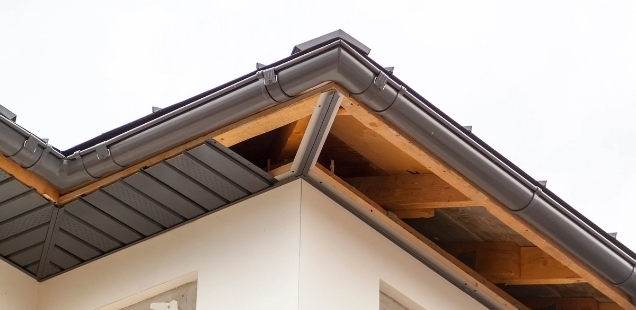
all four elevations, not just the section that came loose.
The gutter usually has to come off to see the wood it is fixed to.
where rot has reached the ends of the roof structure.
from inside, because blocked vents are common and invisible from the ground.
for rot found on removal, and pest clearance where it applies.
to match.
Here is the sequence that turns a small gutter fault into carpentry, and it happens on a great many North Texas houses without anybody noticing.
A gutter joint splits, or a blockage causes an overflow. Water runs down the back of the gutter rather than through it, straight onto the fascia board it is fixed to. Fascia is usually wood, painted on the face you can see and often unsealed on the back you cannot. It stays wet.
Wet wood rots, invisibly, because it is behind a gutter nobody has moved in a decade. The hangers lose their grip, the gutter sags, the overflow worsens, the rot accelerates. Eventually a section comes away from the house, and only then does anyone look.
By that point the job has grown: fascia replacement, sometimes rafter tail repair, then new gutter. Which is why gutter repair and fascia work belong with the same contractor. Rehanging a gutter on rotten fascia is a repair with an expiry date.

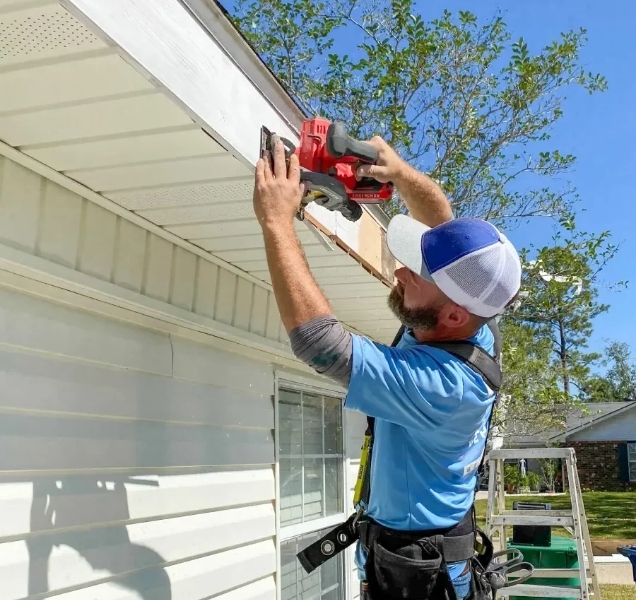
Wood. Traditional, paintable, matches older houses, and it rots when it stays wet. Most of the fascia in this region is wood, and it works well when sealed on all faces with a gutter above it doing its job.
Aluminum wrap over wood. Very common on newer construction, and it carries a serious catch: the wood is still in there. If water gets behind the wrap, the wood rots invisibly and the first sign is a section coming loose. Wrapped fascia needs checking, not ignoring.
Vinyl soffit. Light, vented, inexpensive, more brittle in cold weather, and straightforward to replace individually if the profile is still available.
Aluminum soffit. More impact resistant than vinyl, dents rather than cracking.
Fiber cement. Used for both on some newer builds. Durable and heavy, and it needs cutting and handling properly.
We match what is there, and where a profile has been discontinued we tell you before the work.

We take the gutter off to look behind it, rather than quoting a roofline from the ground.

We check attic intake, because restoring blocked ventilation is often the cheapest improvement available to an aging roof.

We quote a fascia rate for rot found on removal, so the variable is priced in advance.

We clear the cavity before closing it, rather than boarding over something still living in there.

We photograph the whole eave line on a storm inspection, which is where most of this damage is lost.

One contractor for roof, gutter and fascia, because that junction is where three trades usually blame each other.
We repair soffit and fascia across:
Our office is on Preston Road in Frisco.
Damage here rarely travels alone. Related work includes gutter repair, exterior trim and carpentry and storm damage repair. If a storm caused it, start with a free roof inspection .
 4.9★ Rating from 1,235+ Texas Roofing Customers

Three things, roughly in this order. The attic loses its air intake, so ventilation stops working and the roof deck bakes from underneath. Moisture gets into the cavity and the structure behind it. And birds, squirrels, wasps and rodents use the gap as an entrance to your roof space. The third turns a carpentry job into a clearance job.
Usually because water is running down the back of the gutter rather than through it, from a split seam, a blockage or an overflow, and soaking the board it is fixed to. The gutter can look perfectly good from the front while the wood behind it has been wet for years.
Often yes, if the rest of the run is sound and the material can be matched. The judgment call is whether the adjacent boards are also wet, which you cannot tell from the ground. We check the run either side of the obvious damage before pricing.
Yes. They are the intake for your whole attic ventilation system. If they have been blocked, painted over, or buried under insulation pushed into the eaves during an attic upgrade, your attic has an exhaust with nothing feeding it.
Almost always. Birds find an existing gap where a panel has slipped or a joint has opened, and they return persistently. The repair has to clear the cavity first and then close the route properly.
Storm damage to them is commonly part of a property claim, and it belongs on the same claim as the roof because it came from the same storm. Whether your policy covers a given item is between you, your policy and your agent. What we control is that it gets documented rather than overlooked.
No, and this is a common misunderstanding. The wrap is a cover over a wooden board. If water gets behind it the wood rots without any visible sign, and the first symptom is usually a gutter section coming loose.
An elevation is often a day. A full perimeter, or work that turns out to involve rafter tails, takes longer. Gutters come off and go back on around it, which adds time and is not optional if the job is to be done properly.
Yes, and it is the sensible order. The gutters are coming off for a re roof anyway, the access is already there, and the drip edge detail at the eave is exactly where the roof, the fascia and the gutter meet.
If your gutters have sagged, a section has come away, or something is nesting above your eave, the problem is very likely behind the fascia rather than in front of it.
Call (469) 598-0899 or request a free estimate.
© Copyrighted 2026 All Around Texas Roofing. All Rights Reserved. Powered by Fast Hippo Media.
 info@allaroundtexasroofing.com
  Schedule Now
 (469) 598-0899