
All Around Texas Roofing cleans exterior surfaces across Frisco, McKinney, Prosper, Celina, Anna, Melissa, Aubrey and the surrounding Collin and Denton County communities. Driveways, patios, walkways, siding, fences, gutter faces and post storm cleanup.
Each at the pressure that surface can actually take, which is the entire job and the reason most of the damage we get called out to fix was done by somebody else’s pressure washer.
Call (469) 598-0899 and we will tell you what each surface on your property needs.
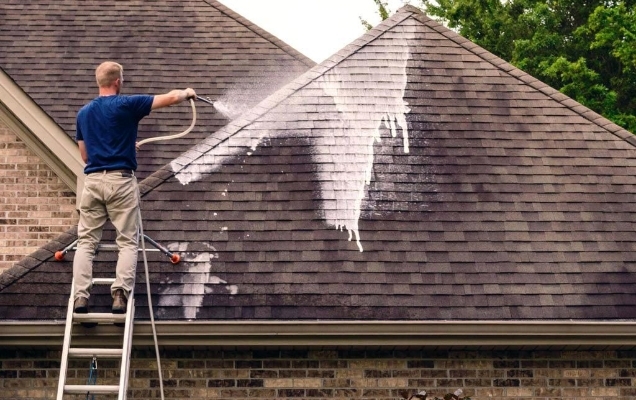
This is the one place the answer is simply no, and we would rather explain it than take the work.
An asphalt shingle is protected by a layer of mineral granules embedded in its surface. Those granules are the shingle’s UV protection and a good part of its weather resistance. They are also, to a pressure washer, loose material sitting on a surface.
A pressure washer removes them. Not all of them, and not visibly on the day, but enough to shorten the life of the roof measurably. You will see them in the gutters and on the ground afterwards, which is the same evidence we use to diagnose hail damage during a free roof inspection.
There is a second problem. A roof is designed to shed water downward over lapped courses. A pressure washer aimed up the slope drives water underneath those laps, past the shingles and onto the underlayment and deck, which is precisely what the lapping exists to prevent.
And a third: many shingle manufacturers’ warranty terms address cleaning methods, and high pressure washing is a common way to find yourself outside them.
If you have black streaks on your roof, they are algae in almost every case, and they are treated with a low pressure application and appropriate solution rather than with a wand. If somebody offers to pressure wash your roof, that is a reason to use somebody else, and it tells you what they will do to your siding.

because “wash the house” is not a scope.
high pressure only on hard flat concrete, low pressure and solution everywhere else.
covering and rinsing where solutions are used near planting.
so nothing is re soiled by runoff.
if staining or painting follows.
before we leave.
This is where power washing meets the rest of what we do.
After a serious storm, properties get covered in the debris of everything that failed: mud and silt across driveways and patios, granules washed off the roof, grit and organic matter thrown against siding, and residue from whatever came down. Left through a Texas summer, that lot stains.
There is also a practical reason to do it early: a clean surface is an inspectable surface. It is considerably easier to assess what a storm did to a driveway, a patio or an elevation once the debris is off it.
Where we are already carrying out storm damage repair, cleanup is scheduled into the same sequence rather than as a separate visit, which is cheaper and means the crew is not arriving twice.

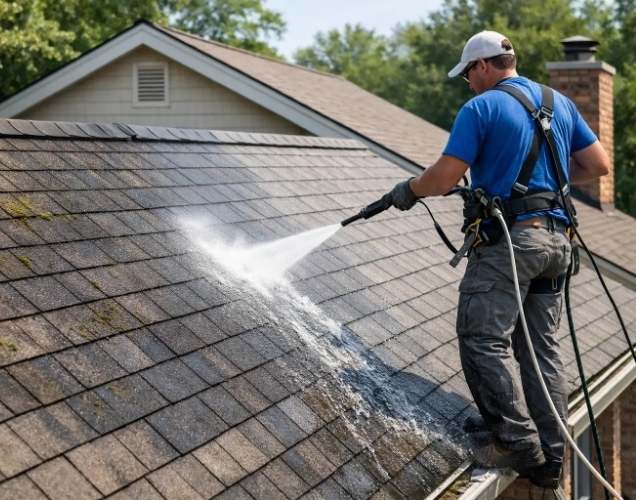
If your fence is going to be stained or your house painted, the clean is preparation rather than a separate job, and how it is done decides how the finish turns out.
Two things matter. The surface has to be genuinely clean, because stain and paint sit on top of whatever is left behind. And it has to be properly dry before anything is applied, which on cedar after a wash means real drying time rather than a token day.
It also has to be washed gently. Wood cleaned at too high a pressure has a raised, fuzzy grain that absorbs stain unevenly and produces a blotchy finish. That is a common cause of a fence staining job looking wrong when the stain itself was fine.
We sequence these together when we are doing both, because it is one mobilization and because the person cleaning has a reason to care how the surface takes the finish.

We match the method to the surface and will tell you which pressure we are using and why.

We will not pressure wash your roof, and we will explain exactly what it would cost you.

We use a surface cleaner on flat concrete, which is what prevents wand striping.

Plant protection is in the scope, not assumed.

We will not quote a cleaning schedule, because the honest answer is when it needs it, not on a calendar somebody sold you.

We are on the roof for a living, so we know what the wrong pressure does to one.
We clean exterior surfaces across:
Our office is on Preston Road in Frisco.
 4.9★ Rating from 1,235+ Texas Roofing Customers

You can, and you should not, and we will not. High pressure removes the mineral granules that give an asphalt shingle its UV protection, and water driven up the slope gets underneath the lapped courses and onto the underlayment. Many manufacturers’ warranty terms also address cleaning methods. If a contractor offers to pressure wash your roof, that tells you what they are likely to do to your siding.
Those streaks are usually algae. They are treated with a low pressure application and an appropriate solution, which lifts the growth without disturbing the granules. It is a different process from washing a driveway and it needs someone who understands what is underneath.
It can, easily. On vinyl and lap siding the risk is water driven up behind the laps and into the wall. On aluminum it is finish damage. On fiber cement it is removal of the coating that keeps water out. All of them wash safely at low pressure with the right solution, worked in the right direction.
Because it was cleaned by waving a wand rather than with a surface cleaner attachment. The wand cleans in an arc, and where the passes do not overlap perfectly you get a visible pattern. It is permanent until the whole slab is redone properly.
Yes, and gently. The surface has to be clean because stain sits on top of whatever is left, and it has to be washed at low pressure because wood cleaned at high pressure develops a raised, furry grain that takes stain unevenly. It then has to dry properly before anything is applied.
They can if nobody takes care of it, which is why plant protection and rinsing belong in the scope rather than being assumed. Ask about it, and if the answer is vague, ask somebody else.
It depends on shade, tree cover and which way the surface faces. North facing concrete under trees grows algae quickly. A sunny south facing driveway can go years. The honest answer is when it looks like it needs it, not on a schedule.
Yes, and it is usually better. If we are already on site for storm repairs, roofing or fence work, cleanup and washing are scheduled into the same sequence rather than as a separate mobilization.
Tell us which surfaces you want cleaned and we will tell you what each one needs, including the ones that should not be pressure washed at all.
Call (469) 598-0899 or request a free estimate.
© Copyrighted 2026 All Around Texas Roofing. All Rights Reserved. Powered by Fast Hippo Media.
 info@allaroundtexasroofing.com
  Schedule Now
 (469) 598-0899