
All Around Texas Roofing stains cedar and wood fences across Frisco, McKinney, Prosper, Celina, Anna, Melissa, Aubrey and the surrounding Collin and Denton County communities. New fences, weathered fences, and repaired sections that need blending into the run.
Most bad stain jobs are not stain problems. They are timing and preparation problems, and both are covered below.
Call (469) 598-0899 and we will tell you whether your fence is ready.

Stain sits on top of whatever is already there. That single sentence explains most bad stain jobs.
A weathered fence needs cleaning first, and it needs cleaning gently. High pressure will strip the surface, but it also raises and furs the grain, and furred wood absorbs stain unevenly and produces the blotchy result people blame on the product. Low pressure, an appropriate cleaner, and patience. See power washing for how we handle that.
Then it has to dry.
On a fence that has been repaired there is an additional problem, because new boards and weathered boards absorb stain at completely different rates. The same product applied at the same time will look different on each. That is manageable, and it is one reason fence repair and staining are worth sequencing together with somebody who knows the repair is there.
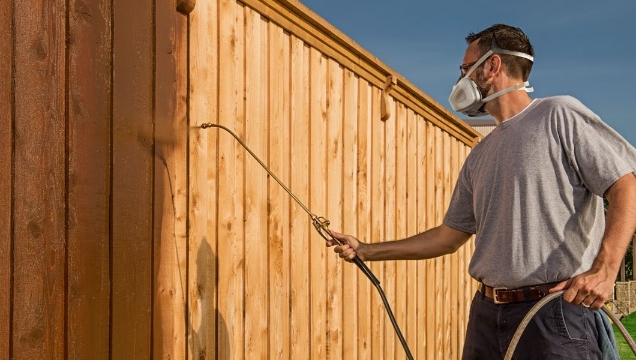
not the calendar. If it is not ready we say so and come back.
with an appropriate cleaner, not a wand on full.
between cleaning and staining.
before any material is ordered.
because stain on a patio does not come off.
blending across old and new boards where a repair has been made.
Stain penetrates. It soaks into the wood and colors it, and when it wears it wears thin and fades. Recoating is a clean and reapply.
Paint forms a film on the surface. When it fails, and on a fence exposed on two sides it will, it fails by cracking, blistering and peeling. Recoating then means removing the failed film first, which on a board on board cedar fence with hundreds of boards and gaps is a genuinely unpleasant job.
For fences in this climate, stain is almost always the right answer. Semi transparent products let the grain show and refresh easily. Solid color products give more coverage and more UV protection while reading closer to paint, and they are the usual answer when a fence has weathered unevenly or has mixed board ages.
We will tell you which suits your fence, and if you want a solid color we will tell you plainly that it is a harder finish to walk back from later.
One thing stain does not do is stop rot at the base of a post, because that is about ground contact and drainage rather than surface finish. Anyone selling staining as structural protection is overselling it.
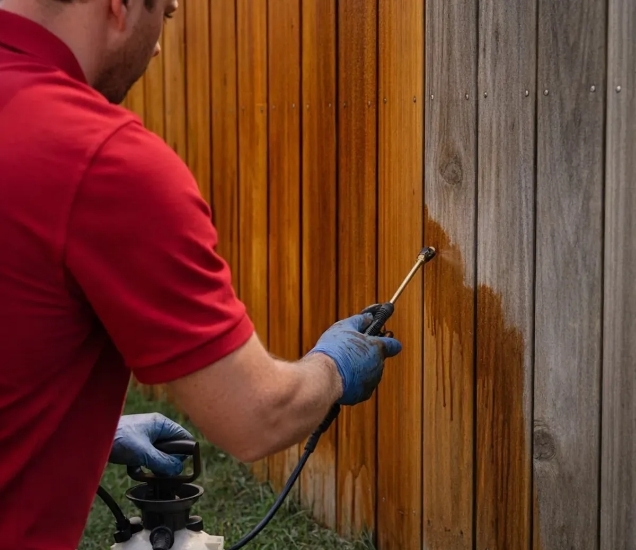

In most master planned neighborhoods across this service area, fence stain color is specified by the architectural committee, and the specification is not a suggestion.
Committees commonly set the permitted color or a short approved list, sometimes name a product, and sometimes require that the whole fence be done rather than one section. Some require submission and approval before work starts.
The order that matters: get the HOA answer, then buy the material. Not the other way around. Staining a fence in the wrong color means stripping or recoating it in the right one, and that is the most avoidable expense in this trade after ordering the wrong shingle.
We handle the submission where one is required, and where you already know the approved product we will use it.

We check the wood before staining, rather than working to a date.

We will not clean and stain on the same day, and we will explain why when asked.

We clean at low pressure, because furred grain is what makes a stain job blotchy.

We settle the HOA color before material is ordered.

We stain the whole run after a repair, not just the new section, which is the difference between a fence and a patched fence.

We will tell you stain does not stop post rot, because it does not.
We stain fences across:
Our office is on Preston Road in Frisco.
If a storm took a section of your fence, the repair and the finish are really one job. See fence repair and replacement, and storm damage repair for whatever else the same storm touched.
 4.9★ Rating from 1,235+ Texas Roofing Customers

Long enough for the wood to dry out, which depends on how wet the lumber was, how hot and dry the weather has been since, and which way the fence faces. There is no single correct number of weeks, and a contractor who gives you one without looking at your fence is guessing. We check the wood rather than the calendar.
Usually one of three things. The wood was still too wet, so the stain could not penetrate evenly. The surface was cleaned at too high a pressure, raising the grain so it absorbed unevenly. Or new and weathered boards in the same run took the same product at different rates. All three are preparation problems rather than product problems.
Stain, in almost every case here. Stain penetrates and fades; paint forms a film and eventually peels, and stripping failed paint from a board on board cedar fence is a miserable job. If you want more coverage than a semi transparent stain gives, a solid color stain gets most of the way there without the peeling.
In most master planned neighborhoods here, yes. Committees commonly specify the color, sometimes name a product, and sometimes require the whole fence rather than a section. Settle it before material is ordered. We handle the submission where one is needed.
We can, and whether it is included is a line on the quote rather than an assumption. Staining one side only is common, cheaper, and leaves the neighbor’s side weathering differently, which matters if the fence is shared or visible from the street.
Not immediately. New cedar is a different color from weathered cedar and stays that way for a long time. Stain narrows the gap considerably, and a solid color product narrows it further. The important thing is to stain the whole run rather than just the repair, and to let the new wood dry first.
It depends on product, exposure and which way the fence faces, and the sun facing elevations always go first. Rather than quote a schedule, we will tell you what yours looks like when we see it.
No, and be wary of anyone who says yes. A washed fence is a wet fence, and stain applied to wet wood does not penetrate. It needs real drying time between the two, which means two visits.
Whether the fence is new, weathered or just repaired, the answer starts with whether the wood is ready.
Call (469) 598-0899 or request a free estimate.
© Copyrighted 2026 All Around Texas Roofing. All Rights Reserved. Powered by Fast Hippo Media.
 info@allaroundtexasroofing.com
  Schedule Now
 (469) 598-0899