 info@allaroundtexasroofing.com
 Schedule Now
 (469) 598-0899
A flat roof on a McKinney shop, office, or strip center rarely fails all at once. It fails one puddle, one split seam, and one stained ceiling tile at a time, and the owner usually hears about it from a tenant. The good news is that low-slope roofs give plenty of warning. The trick is reading it early enough that a repair is still an option.
TL;DR
Flat roofs are built with a slight slope so water drains away, and most of their problems start where water stops moving: ponding, open seams, failed flashing at walls and curbs, and hail bruising. A sound membrane with isolated problems can usually be repaired, and a sound but aging roof can sometimes be restored with a coating made for that membrane.
Wet insulation, widespread seam failure, or repeated leaks usually mean replacement. McKinney adopted the 2024 International Building Code in October 2025, so a replacement is built to that edition. Walking every drain and seam is the fastest way to know which of the three you face.
Why Flat Roofs Leak Where They Do
Every leak on a low-slope roof traces back to one idea: water that stays on the roof long enough eventually finds a way in.
A steep shingle roof sheds rain in seconds. A low-slope roof moves it slowly toward the drains, which means every weak point spends much longer underwater. Where water lingers is where things fail.
Even residential code treats slope as part of the roof system. Section R905.13.1 of the 2024 International Residential Code, for example, requires sprayed foam roofs to have a design slope of not less than a quarter unit vertical in 12 horizontal for drainage. Commercial low-slope roofs follow the same logic under the building code.
| Where it fails | Why it fails there |
|---|---|
| Low spots in the field | Water ponds, the membrane stays wet, dirt and debris collect |
| Seams and laps | Heat cycling and movement pull them apart over time |
| Walls, curbs, and parapets | Flashing is the transition between two materials, and transitions move |
| Drains and scuppers | Leaves, grit, and debris block them, and water backs up |
| Rooftop units and pipe penetrations | Every hole through the roof needs its own seal |
What Ponding Water Is Doing to Your Roof
Ponding is water that stays on a low-slope roof long after the rain has stopped. It is one of the most common flat roof complaints, and it is worth taking seriously even when nothing is leaking yet.
Standing water does several kinds of damage at once:
- It keeps the membrane wet, which speeds up aging of many membrane types
- It adds weight to the structure, which can deepen the low spot over time
- It collects dirt that grows algae and plants
- It turns every small defect under it into a leak
How to tell ponding from normal drying
After a normal North Texas storm, a sound low-slope roof should be draining and drying steadily, not holding the same puddles days later. If the same spots hold water after the rest of the roof is dry, or if you can see rings of dirt and staining where puddles sit, the roof is ponding. Photograph the spots with the date. That record helps any roofer find the cause.
Common causes
Ponding usually starts with one of four things: a blocked drain, insulation that has compressed under foot traffic or equipment, structure that has deflected over the years, or a roof that was never built with enough slope in that area. The fix depends on which one it is. Clearing a drain costs almost nothing. Adding tapered insulation to rebuild slope is a real project.
Membrane Types on McKinney Commercial Buildings
Commercial buildings around McKinney, Allen, and Frisco commonly carry one of four low slope systems. Knowing which one you have matters, because each fails differently and each is repaired differently.
| System | What it is | Typical weak point |
|---|---|---|
| TPO single ply | A white or light thermoplastic sheet with heat-welded seams | Seams and flashing details |
| Modified bitumen | Asphalt-based sheets in layers, often with a granule surface | Laps, blisters and surface wear |
| Built-up roofing | Layers of felt and asphalt, often with gravel | Blisters, splits and drains |
| Metal | Panels with standing or through-fastened seams | Fasteners, seams, and rust at low points |
Those are the four systems our commercial roofing team installs and services. If you do not know what your building has, the answer is usually visible from a roof hatch in a minute.
Why a white roof still gets hot inside
Many TPO roofs are white because a reflective surface keeps the roof cooler. The EPA’s guide to cool roofs and heat islands lists reflective single-ply membranes and light colored liquid applied coatings among its low-slope cool roof products. A reflective surface only helps if it stays clean, though. The same guide notes that low-slope cool roofs may need periodic cleaning to keep their reflectance.
What Hail Does to a Low Slope Roof
Collin County sees hail most years. The NOAA Storm Events Database records hail reports in the county every year from 2021 through 2025, on 38 separate hail days in all. A flat roof takes that hail full on. The damage often looks like nothing from the ground and very little from the roof hatch.
On a single-ply membrane, hail can bruise or fracture the membrane over the insulation below, especially where the insulation is soft. On modified bitumen, it knocks away the granule surface and can crack the sheet. On metal, it dents panels and can damage coatings and fasteners.
The Insurance Institute for Business and Home Safety studies exactly this. Its research program on hail impact performance of low slope metal roofing, run with the Metal Building Manufacturers Association, notes that hail alone is responsible for billions of dollars of roof damage in the United States every year, and that the growing range of roofing systems calls for testing beyond shingles.
After any hailstorm big enough to dent cars in McKinney, look at the roof, or have it looked at, even if nothing is leaking. Hail damage on a flat roof often shows up as a leak months later, which is a harder conversation with an insurer than one that happens the week of the storm.
Write down the storm date
Insurers ask when the damage happened. Keep a note of the date of any storm that brought hail to your building, a few photos of hail on the ground or dents on cars and equipment, and the date you first noticed any new leak. That short record makes it far easier to tie damage to a specific event later.
Repair, Restore or Replace?
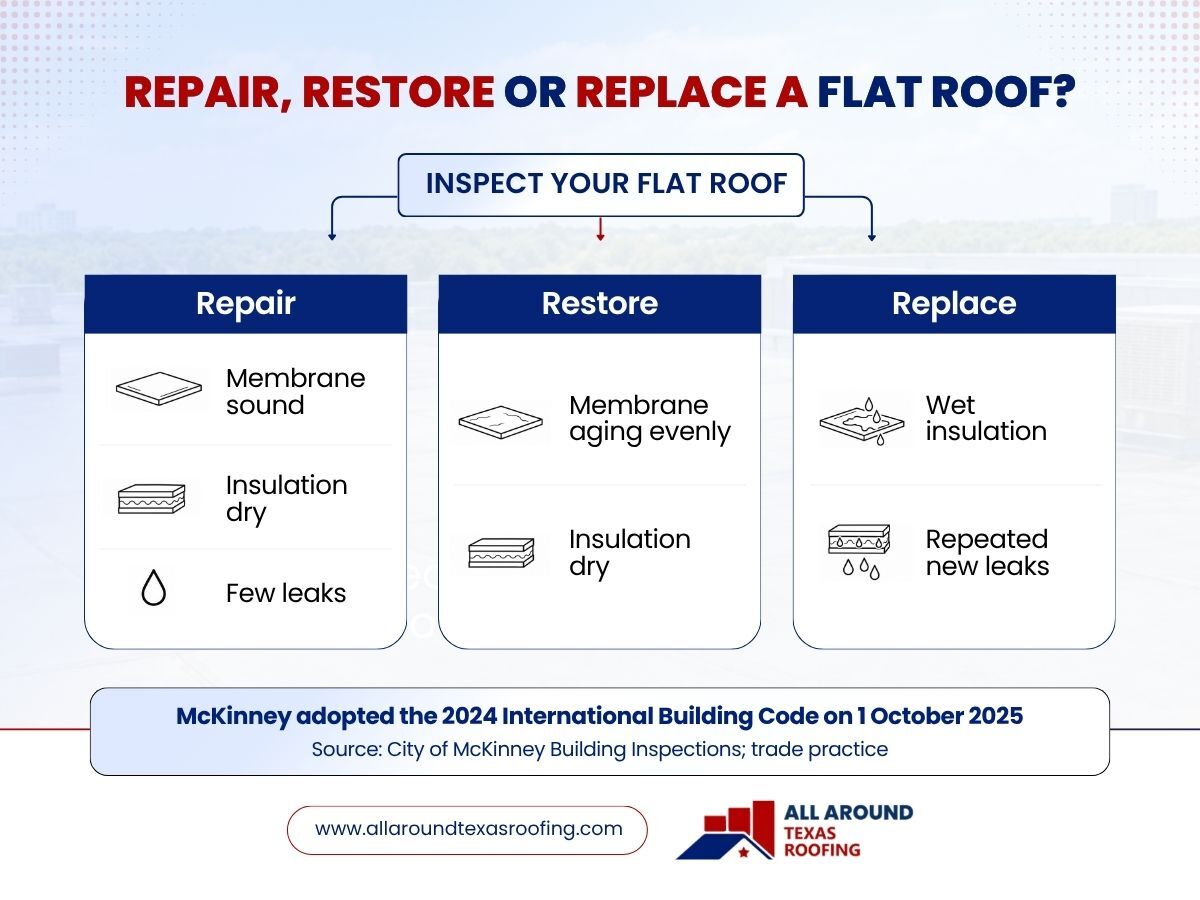
This is the decision every flat roof owner faces eventually, and it turns on two questions: is the membrane itself still sound, and is the insulation under it still dry?
| Condition | Usually points to |
|---|---|
| A few leaks at seams or flashing, membrane otherwise sound, insulation dry | Repair |
| Membrane aging evenly, few leaks, insulation dry, no major ponding | Restoration with a coating system made for that membrane |
| Wet insulation in large areas | Replacement of the wet sections or the whole roof |
| Repeated leaks in new places every season | Replacement |
| Ponding from structural low spots or missing slope | Repair or replacement that rebuilds the slope |
Why wet insulation changes everything
Water that gets under a membrane soaks into the insulation board and stays there. Wet insulation insulates poorly, adds weight, and keeps the deck wet from above. Patching the membrane over wet insulation traps the water in, which is why a repair on a roof with widespread wet insulation tends to fail again. Finding out how much of the insulation is wet is the most important part of deciding what to do.
What restoration really means
A restoration is a coating system applied over a sound, dry, cleaned roof to extend its life. It is not a way to fix a failing roof cheaply. A coating over wet insulation or over a membrane full of splits does not stop the problem underneath.
Building to the Current Code in McKinney
If the answer is replacement, the new roof is built to whatever code the city has adopted when the permit is pulled. The City of McKinney’s building inspections code page states that the city adopted the 2024 codes, including the 2024 International Building Code, on 1 October 2025, with local amendments.
That matters in practical ways. A reroof on an older building can bring requirements the original roof never had, and the details belong in the scope before the project is priced, not after the permit review comes back.
It is one more reason to get a written scope from whoever inspects the roof, listing what exists, what is wet, and what the replacement has to include.
Questions to Ask Before You Sign a Flat Roof Proposal
Flat roof proposals vary more than shingle quotes do, because the scope depends on what is under the membrane. These questions separate a proposal you can compare from one you cannot.
- How much of the insulation did you find wet, and how did you check?
- Is the proposal a repair, a restoration, or a replacement, in those words?
- What happens to the existing roof: removed or covered?
- How are drains, scuppers, and low spots being addressed?
- Which flashings and curbs are being replaced, and which reused?
- What manufacturer warranty applies, and what does it require from the owner?
- Is the permit included, and who handles inspections?
Two proposals for the same building can differ wildly in price because one includes tapered insulation to fix the ponding and the other does not. Neither is wrong on its face. What matters is knowing which problem each one solves.
Working Around Tenants and Business Hours
A flat roof job on an occupied building is as much about logistics as roofing. Tenants need access, deliveries still arrive, and rooftop units may need to be shut off for a stretch.
Talk through these before a start date is set:
- Which entrances and parking areas will be blocked, and when
- Whether any rooftop units need to be shut down, and for how long
- Where materials and waste containers will sit
- How interior areas under active work will be protected
- Who the tenants should call with a problem during the job
For a retail center or a medical office in McKinney, a phased schedule that keeps part of the building fully open is often worth a slightly longer job.
A Simple Maintenance Routine for a Flat Roof
Most of what goes wrong on a flat roof starts small, which makes a short routine worth more on a low-slope roof than on almost any other.
- Clear drains, scuppers, and gutters, especially after the fall leaves come down.
- Walk the roof after a heavy storm and note where water is still standing a few days later.
- Look at every flashing where the roof meets a wall, curb, or unit.
- Check around rooftop equipment after any service visit, because technicians are hard on membranes.
- Keep a dated photo log. It is the best evidence you will have if a claim ever comes up.
A tenant’s stained ceiling tile is the last warning, not the first.
Have Your McKinney Flat Roof Walked Before It Leaks Again
If your building has a flat roof in McKinney, Allen, Frisco, or anywhere else across Collin County, the first step is a walk of every seam, drain, and flashing, and an honest read on which of the three the roof needs. Our roof inspection page explains what an inspection covers, and our McKinney roofing page covers the local details.