 info@allaroundtexasroofing.com

 Schedule Now
 (469) 598-0899
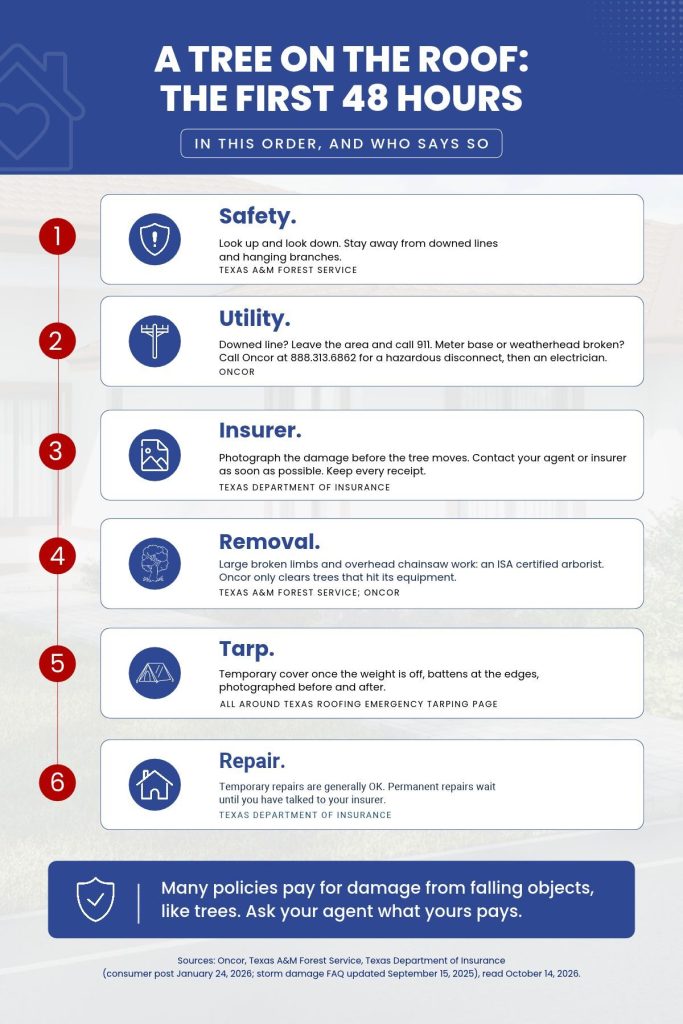
Get everyone out from under the impact, stay well clear of any wire the tree touched, and call 911 if a line is down. Then photograph the damage before anything moves, call your insurer, have an arborist take the weight off, and get the opening covered. On who pays, the Texas regulator’s answer usually starts with your own homeowners policy, even when the tree was your neighbor’s.
TL;DR
A tree on a Texas roof is handled in a fixed order. Safety comes first: Oncor tells anyone who sees a downed power line to stay away, keep people away, and call 911, and the Texas A&M Forest Service says large broken limbs and overhead chainsaw work are a job for an ISA-certified arborist. Next, photograph the damage before the tree is moved, which is the first step the Texas Department of Insurance (TDI) lists; then contact your agent or insurance company as soon as possible. Temporary repairs such as a tarp are generally fine, and permanent repairs should wait until you have talked to the insurer. On who pays, TDI says many policies cover damage from falling objects, many give some coverage to remove a tree that hit the house, and a neighbor’s policy probably will not pay unless the neighbor was at fault.
The First Hour: Is Anyone Hurt, and Is a Line Down?
Account for everyone, then look up before you look at the roof. A tree that comes down onto a house can take a service line or a cable line with it, and Oncor’s instruction in its post on what to do after a storm passes is to stay away, keep people away, and call 911 immediately. Oncor’s safety page goes further: never approach, touch, or try to move a downed line or anything in contact with one.
The order below is for the first hour, before anyone thinks about shingles.
- Get everyone out of the rooms directly under the impact. A trunk resting on a roof is still loading the framing, and a ceiling can let go after the tree has stopped moving.
- From a distance, look for wires on the ground, in the branches, and across the fence. The Texas A&M Forest Service warns that even fence wires can become electrically charged when broken electrical lines are nearby.
- If a line is down, leave the area and call 911. Oncor’s safety page says the 911 operator contacts Oncor directly, and downed lines can also be reported at 1.888.313.4747.
- If water is coming in and it is safe to be inside, turn off the breaker for any circuit with water reaching a light fixture or an outlet, then carry what you can out of the room.
- Leave the tree where it is and stay off the roof. The Forest Service is plain about hanging limbs: do not get under broken branches caught overhead.
When the tree took the meter or the mast with it
Oncor draws a line here that is easy to miss. Falling limbs can break equipment the homeowner is responsible for maintaining, and Oncor names the meter base and the weatherhead as examples. Its process for that case has four steps.
| Step | Who does it |
|---|---|
| Call Oncor at 888.313.6862 for a temporary hazardous disconnect | You |
| Repair or replace the broken meter base or weatherhead | Your electrician |
| City inspection of the electrical work, where the city requires one | The city, which then confirms to Oncor |
| Call 888.313.6862 again to request the reconnect | You |
If a different utility or an electric cooperative delivers power to your address, use the number on its bill. The point that carries over is that the roof repair and the electrical repair run on separate tracks, so book the electrician on the first day rather than after the roof is closed.
Who pays, first hour. Oncor repairs Oncor’s equipment. The meter base and weatherhead on the house are the homeowner’s to maintain, according to Oncor, so the electrician’s bill starts as yours. Whether your policy treats it as part of the house damage is a question for your agent.
The First Day: Photos, One Phone Call and a Dry House
Once nobody is in danger, the next 24 hours decide how clean the rest of the job is. Two mistakes made on this day are hard to undo later: a tree cut up before anyone photographed it, and a permanent repair started before the insurer heard about the loss.
Photograph everything before the tree moves
The Texas Department of Insurance puts this first in its January 24, 2026 consumer post on fallen trees: take photos of the damage before you move the tree, make repairs, or take other steps to prevent more damage.
Shoot from the ground. Nobody needs to be on that roof to document it.
- A wide shot from the street showing the whole tree and the house together
- Each side of the house the tree touched, including the gutter line and the fascia
- The base of the trunk or the broken stump, with the fence or property line in frame
- Every room with a ceiling stain, a crack, or water on the floor
- Anything else under the canopy: the fence, the patio cover, the cars
Call the insurer, then keep every receipt
The same post says to make temporary repairs to prevent more damage and to contact your agent or insurance company as soon as possible. It adds that you should save your receipts, because a homeowner policy should cover the materials and labor used to make those repairs.
TDI’s storm damage FAQ draws the line on timing. It is generally OK to make temporary repairs, but permanent repairs wait until you have talked to your insurance company.
A tarp and a cleared roof are temporary. New decking and shingles are permanent.
The tree comes off before the roof can be closed
Taking the weight off a roof is tree work, and tree removal is not on our service list. The Texas A&M Forest Service’s guidance on storm damaged trees is specific about who should do it: if large limbs are broken or hanging, or if high climbing or overhead chainsaw work is needed, it is a job for an ISA-certified arborist. The agency’s disaster page also warns against hiring just anyone who shows up at your door after a storm.
Oncor’s role here is narrow. If trees hit or threaten its equipment, Oncor’s contractors clear those limbs and haul away the brush from that work, which can take days or weeks after a major outage. Oncor will not cut or remove trees that fell on your property without touching its equipment.
When you call a tree service, ask one question before anything else: how will they take the weight off without dropping sections onto the roof? A careless cut on a trunk lying across a ridge can turn one hole into three.
The tarp goes on once the weight is off
A limb through the roof surface is one of the openings our emergency roof tarping page lists under “When You Need It Tonight”. The tarp we install works as a temporary roof: battens hold its edges down against the wind, and the cap nails go into material the permanent repair will replace or cover.
We photograph the damage before the tarp goes on, then the install, then the finished cover, and we record the materials, the labor, and the time of the call so the emergency work stands as its own record. Emergency tarping is chargeable, and you hear the price before any work begins. We will not send a crew up while lightning is active or while the wind makes handling material dangerous.
We tarp and board up across Frisco, McKinney, Prosper, Celina, Anna, Melissa, and nearby towns in Collin and Denton County, from our office on Preston Road in Frisco. Please do not tarp it yourself. A roof that just took a tree is often wet, littered with debris, and soft in places nobody can see from the top of a ladder.
Who pays, first day. TDI says a homeowner policy should cover the materials and labor used for temporary repairs, so keep the tarp invoice. For removal, TDI says many policies provide some coverage to remove trees or limbs that fell due to storm damage and damaged your house or blocked your driveway. What your policy pays, and up to what amount, is on the policy itself.
Does Homeowners Insurance Cover a Tree That Falls on a Texas House?
Often, for the house itself. The Texas Department of Insurance answers the question “will insurance pay when a tree crashes down on your car or house?” with one word: “Sometimes.” Its answers depend on what the tree hit and whose tree it was, so the useful version is a table. Every row below is TDI’s general description of typical policies, read on October 14, 2026, and TDI’s recurring advice beside them is to call your agent or company to ask if your policy will pay.
| Situation | What TDI says about typical policies | Where TDI says it |
|---|---|---|
| Tree fell on roof or house | Many policies pay for damages from falling objects, like trees | Consumer Post, January 24, 2026 |
| Removing a tree that hit the house or blocks the driveway | Many policies provide some coverage | Consumer post |
| Tree fell in the yard and hit nothing | Usually not covered | Consumer post |
| Neighbor’s tree fell on your house | Their policy probably will not pay unless they were at fault; you can file under your own policy | Consumer post |
| Tree fell on your car | Your auto policy pays “if you have comprehensive coverage” | Consumer post |
| A windstorm brought the fence down | If the policy covers wind, likely some coverage, usually limited to actual cash value, and you pay the deductible | Storm damage FAQ, updated September 15, 2025 |
| Tree hit a detached garage or shed | Typically covered, probably up to 10% of the amount the house is insured for | Storm damage FAQ |
| Damage forces you out of the house | Your policy may pay for a hotel or rental if the damage is covered; check the limits | Storm damage FAQ |
Two things are missing from that table on purpose. TDI does not publish a dollar figure for tree removal, and it does not promise any outcome. A roofer who tells you “your insurance will cover all of it” before anyone has read your declarations page is guessing.
What If It Was Your Neighbor’s Tree?
Start with your own policy anyway. Asked “My neighbor’s tree fell on my house”, TDI answers that the neighbor’s policy probably will not pay for the damage and the removal unless the neighbor was at fault, because your neighbor is not responsible for acts of nature. If the neighbor’s policy does not pay, you can file a claim under your own.
Whose tree it was is less obvious than it sounds when the trunk sits near a fence. The Texas State Law Library’s guide to trees and neighbor law says Texas has no specific state statute on this, and court cases have filled the gap: the location of the trunk generally determines who owns the tree, with exceptions. A neighbor may trim limbs back to the property line, though the library notes they could be sued if they injure the tree or other property doing it.
- Photograph the stump or broken trunk with the fence or a survey marker in the frame
- Tell your insurer the tree came from next door, and give them the neighbor’s name if you have it
- Check whether your city or your property owners’ association has its own tree rules, which the library says both can
The library is also careful to say it cannot tell you what the law means for your situation, and TDI does not define “at fault”. If the neighbor’s tree was dead or leaning for months and you argue about it, that is a conversation for a lawyer, not for a roofer or a tree crew.
Who pays: neighbor’s tree. Usually your own policy first, per TDI. A neighbor’s policy enters the picture mainly when the neighbor was at fault.
The First Week: Everything Else the Tree Touched
What you can see from the driveway is seldom the whole of the damage, and a tree is the clearest case of it. The trunk lands in one place, but the load travels down the rafters, across the decking and into whatever the canopy hit on the way down. The week after the tarp is when all of it gets looked at.
| Part of the property | What to look for | Who usually looks |
|---|---|---|
| Rafters, trusses, and decking near the impact | Cracked or split framing, a sag in the roof line, nail pops in the ceiling below | Roofer, from the attic and the roof |
| Ridge, valleys and roof edges | Shingles torn loose well away from the hole, a bent drip edge | Roofer |
| Gutters and fascia | Crushed sections, gutter pulled off its hangers, cracked fascia board | Roofer |
| Ceilings and walls inside | Stains, sagging drywall, wet insulation | Roofer first, then whoever repairs the room |
| Fence | Leaning posts, snapped panels, a gap the dog will find | Fence crew |
| Patio cover or pergola | Broken beams and rafters, cracked panels, a pulled ledger at the house | Carpenter or roofer |
| Weatherhead, meter base, service drop | Bent mast, torn wires at the house | Electrician, after Oncor’s disconnect |
A falling limb that crosses a patio cover usually breaks beams and rafters and takes several panels with it, which is why our patio cover and pergola repair inspections walk every outdoor structure, not just the roof. The same goes for the fence line: on a storm inspection, we photograph the whole run, and rebuilding a storm damaged fence starts with pushing every post rather than replacing the two panels the trunk flattened.
Inside, water that got in before the tarp went on keeps moving after it. Our guide to drying and repairing a stained ceiling covers what to wait for before anyone paints.
The roof itself starts with a free roof inspection once the tree is off and conditions allow. We go over the whole roof and the other parts of the house the tree reached, not only the hole, and then schedule the permanent repair based on material availability.
Who pays, first week. Per TDI, the house usually sits under your dwelling coverage, a detached garage or shed under a separate limit TDI describes as typically up to 10% of the dwelling amount, and a fence usually at actual cash value after your deductible. Your declarations page has the real numbers for your policy.
Why a North Texas Ice Storm Changes the Answer
Winter brings a risk to Collin County trees that summer storms do not: ice adds weight to limbs that were fine in July. The Texas A&M Forest Service points to Winter Storm Uri in February 2021 as proof that Texas winters can still be hard on trees. A limb carrying ice does not need wind to come down.
The insurance answer shifts with it. According to the storm damage FAQ, many homeowners policies pay if the house was damaged by the weight of sleet, snow or ice. Its answer for a fence is different: some policies exclude damage from the weight of ice or snow, unless the falling tree hit your house and caused part of it to collapse onto the fence. So the same limb can be covered on the roof and excluded on the fence next to it.
If the tree is an oak, tell the arborist before the first cut. The Forest Service says new wounds made on oaks during cleanup should be painted immediately with wound dressing or latex paint, one cut then paint before the next, and that cosmetic pruning of oaks should wait until summer. It says to avoid pruning oaks from February through June. The same page is plain about power lines: do not remove limbs on or near power lines.
Where Our Work Starts and Where Texas Law Stops It
We cover the opening, document the emergency work, inspect the whole roof for free, and make the permanent repair. We do not remove trees, and we do not file or negotiate your insurance claim.
That second line is the law, not modesty. TDI’s page for roofers states that Texas does not allow a roofer or contractor to act as a public insurance adjuster on a claim if they are also doing the work, and it names offering to negotiate claim settlements or file a claim for the policyholder as improper. The statute is Texas Insurance Code section 4102.163. The same TDI page says it is illegal in Texas for a contractor to offer to waive, rebate, or absorb your deductible.
| What a roofer can do here | What a roofer cannot do in Texas |
|---|---|
| Photograph and write up the damage | Act as your public adjuster |
| Tarp and board up, and invoice it as its own line | File or negotiate the claim for you |
| Inspect the roof and give you a written repair scope | Promise to cover, waive, or absorb your deductible |
| Explain what is on the estimate in roofing terms | Tell the insurer it speaks for you on coverage |
When the insurer’s paperwork arrives, our article on what each line of the insurer’s estimate means walks through squares, waste, and depreciation.
You talk to your carrier. We talk about the roof.
One more rule we keep: we do not knock doors after storms. If someone knocks on your door the morning after a tree comes down, the Forest Service’s advice about arborists applies to roofers too.
Your Next Call, in Order
If the tree is still on the house, the order is the one at the top of this page: people out, lines reported, photos taken, insurer called, arborist booked. Once the weight is off, the roof needs closing before the next rain, and that is where we come in.
Call (469) 598-0899 with three facts: what is open, whether water is coming in, and whether the tree is off yet. We will give you a real window rather than a comfortable one, explain the tarp cost before we start, and follow it with a free inspection of the whole roof. All Around Texas Roofing works from Preston Road in Frisco and covers McKinney, Prosper, Celina, Anna, Melissa, and the communities around them.