 info@allaroundtexasroofing.com
 Schedule Now
 (469) 598-0899
A few days after the adjuster climbs your roof, a document arrives that decides how much money you get and when. It runs several pages; it is written in a shorthand nobody explains, and most homeowners in Frisco, McKinney, and the rest of Collin County sign off on it after reading only the number at the bottom. That number is the least useful thing on the page.
TL;DR
An insurance roof estimate is a priced list of every task and material the adjuster believes the repair needs, measured in squares of 100 square feet. Near the end, it subtracts two things: your deductible, which Texas law says you must pay, and depreciation, which is the value the roof lost to age. On a replacement cost policy, the depreciation is usually held back and paid later, once the work is finished and billed, and the insurer can ask for proof you paid your deductible before releasing it. The lines worth checking are the measurements, the waste allowance, the tear-off, the flashing and vent items, and anything that should be there and is not. If a line is wrong, the Texas Department of Insurance says you or your contractor can talk to the adjuster about raising the estimate.
What Arrives After the Adjuster Leaves
Most carriers send two things, sometimes days apart. One is a letter saying whether the claim is covered. The other is the estimate itself, which is the working document for everything that follows.
The letter answers “are you paying?” The estimate answers “for what, exactly?”
The Texas Department of Insurance spells that out plainly in its homeowners insurance guide: the adjuster decides how much damage you have and estimates the cost, and the company bases its payment on that estimate. The same guide says the company must accept or deny a claim within 15 business days of getting everything it needs from you, with longer deadlines allowed after major disasters.
How Is a Roof Insurance Estimate Laid Out?
A roof insurance estimate is laid out as a list of line items, each with a quantity, a unit, and a unit price, grouped by area of the house, followed by a summary page that totals everything and subtracts depreciation and the deductible. Roofing lines are priced per square, where one square covers 100 square feet of roof surface.
The layout varies by carrier and by the estimating software the adjuster uses, but the pieces are nearly always the same.
| Part of the estimate | What it tells you | What to check |
|---|---|---|
| Header | Claim number, date of loss, policy, adjuster | The date of loss matches the storm you reported |
| Roof measurements | Total squares, pitch, ridge and valley lengths | The squares roughly match your roof, not a neighbor’s |
| Line items | Each task and material, with quantity and price | Nothing obvious is missing |
| Other elevations | Gutters, siding, windows, fence, if claimed | Collateral damage is listed, not ignored |
| Summary page | Replacement cost, depreciation, deductible, net payment | Which depreciation is recoverable |
The summary page gets most of the attention. The line items are where money actually goes missing.
Squares, Waste and Why the Numbers Look Off
Most homeowners notice two things first: the square count looks bigger than their roof, and the shingle line looks bigger again. Both are normal.
The square count comes from measuring every roof plane, including the pitch. A steep roof has more surface than the footprint of the house suggests, which is why a two-story home in Prosper can carry more squares than a sprawling single-story in Anna.
The shingle line is then larger than the measured area because of waste. Shingles are cut at every hip, valley, and rake edge, and the offcuts cannot be reused. A simple gable roof wastes little. A roof with several hips and valleys, which describes a large share of newer Collin County builds, wastes far more.
The waste allowance is not padding
The waste percentage should rise with every hip, valley, and dormer. If your roof is cut up with dormers and valleys and the estimate applies the same allowance a plain gable would get, that is worth a question.
Starter, ridge, and drip edge are separate
Starter strip along the eaves, ridge cap along the peaks, and drip edge at the roof edges are usually priced as their own lines. A missing ridge cap line on a roof with long ridges is one of the easier gaps to spot.
RCV, ACV and the Depreciation You Get Back Later
This is the part of roofing insurance claim estimating that confuses almost everyone, and it is where the two checks come from.
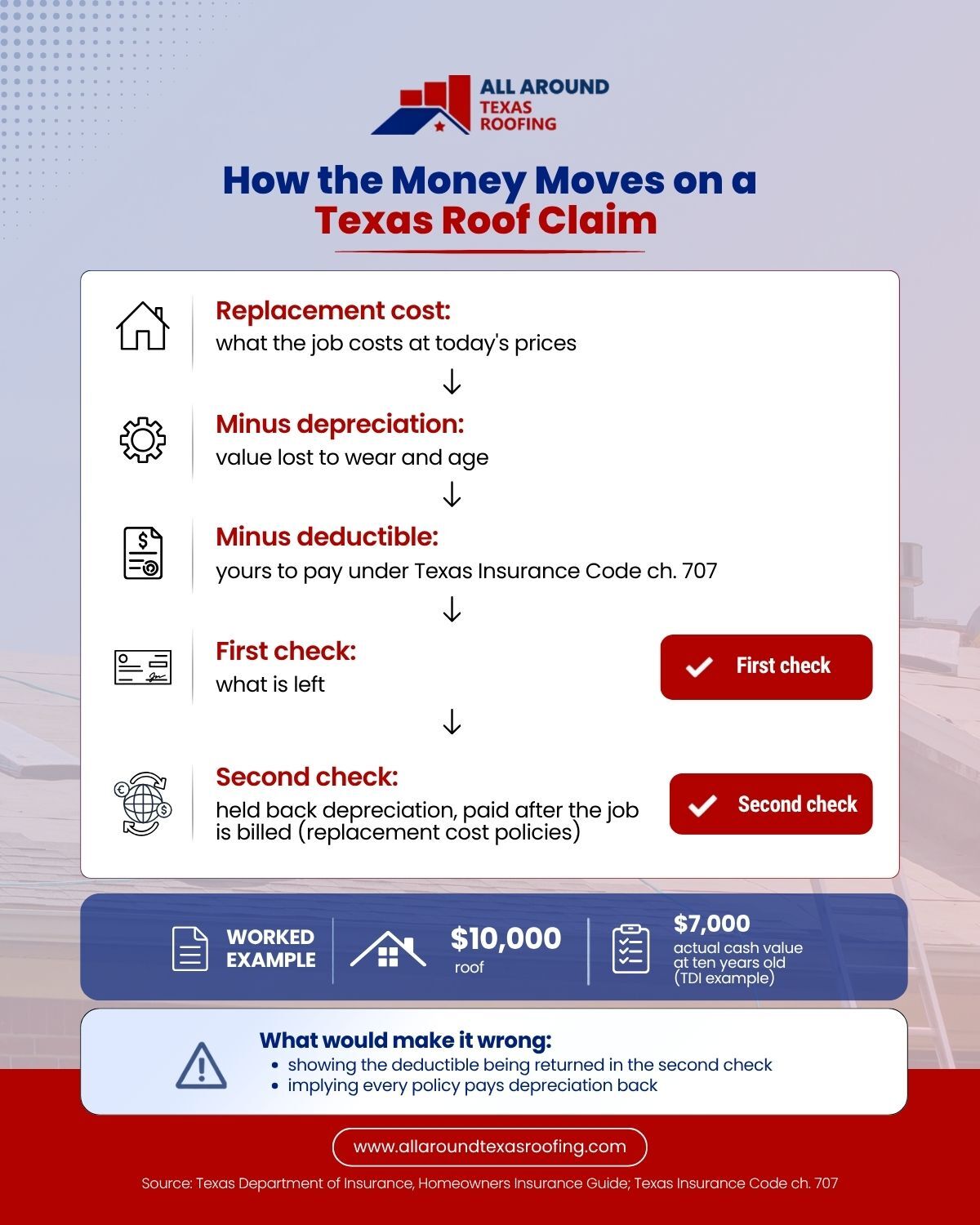
Replacement cost value, or RCV, is what the job costs at today’s prices. Actual cash value, or ACV, is replacement cost minus depreciation, which the Texas Department of Insurance defines as a decrease in value because of wear and age. The TDI guide gives its own example: a roof that would cost $10,000 to replace today might have an actual cash value of $7,000 if it is ten years old.
What you receive depends on which kind of policy you hold.
| Policy type | First payment | Second payment |
|---|---|---|
| Replacement cost | Estimate minus depreciation minus deductible | The held-back depreciation, after the finished job is billed |
| Actual cash value | Estimate minus depreciation minus deductible | None. The depreciation is not paid |
On a replacement cost policy, the department’s guide says most companies pay with two checks, and that you usually must complete repairs within a set period to collect the second. That deadline sits in your policy, not on the estimate, so find it early.
Where the numbers sit on the summary page
Read the summary page from the top down. The first figure is the full replacement cost of every line. Below it sits the total depreciation, and below that the deductible. The figure left over is the actual cash value payment, which is your first check. Somewhere on the page, often in small type, you will see the depreciation split into recoverable and non-recoverable amounts. That split decides the size of your second check, so it is the one line on the summary page worth circling.
If your mortgage company is named on the check, expect a delay. The TDI guide says the lender may ask for a list of the work, cost estimates, and a timeline before releasing money, and must then release all or some of it within 10 days.
Recoverable and non-recoverable lines
Some estimates mark depreciation line by line as recoverable or non-recoverable. Recoverable means you get it back once the work is done. Non-recoverable means you do not. If a large share of the depreciation is marked non-recoverable on a replacement cost policy, read the policy wording on roof surfaces, because some policies settle the roof covering differently from the rest of the house.
The Deductible Line and the Texas Law Behind It
Your deductible appears near the bottom of the summary page, and in Texas it is not optional.
Texas Insurance Code chapter 707 states that a person insured under a property policy shall pay any deductible applicable to a first-party claim. Section 707.004 goes further: an insurer with replacement cost coverage may refuse to pay the withheld depreciation until it receives reasonable proof that you paid the deductible. The statute lists what counts, including a canceled check, a money order receipt, a credit card statement, or a financing contract that pays the deductible in full over time.
Two practical results follow:
- Keep the receipt for your deductible payment with your claim paperwork.
- Be wary of any roofer who offers to cover, waive, or absorb it. The Texas Department of Insurance says plainly that doing so is illegal for a contractor, and your second check can depend on proving you paid.
Items Commonly Missed on a North Texas Roof
Adjusters see a great many roofs in a short window after a hailstorm crosses Collin County, and the estimate is only as complete as the inspection behind it. These are the lines we most often find missing or thin when a homeowner shows us their paperwork.
| Item | Why it goes missing |
|---|---|
| Step and counter flashing at walls and chimneys | Often reused on paper and replaced in reality |
| Pipe boots and roof vents | Hail cracks the rubber collars and dents metal vents, and they are small enough to skip |
| Drip edge at eaves and rakes | Section R905.2.8.5 of the residential code requires it on shingle roofs, and older estimates leave it off |
| Ice and water barrier in valleys | Only listed where someone checked the manufacturer’s instructions |
| A second layer of shingles | Doubles the tear-off, invisible from the ground |
| Steep and high charges | Pitch and height add labor and safety equipment |
| Gutters, screens and downspouts | Dented by the same storm, filed under a different elevation |
None of these is guaranteed to belong on your claim. Each one depends on what is actually on your roof and what the storm did to it. The point is to check that someone looked.
If you are still deciding whether the damage is worth claiming at all, our piece on whether insurance will cover a roof replacement in Texas covers that earlier question.
What Can You Do if a Line Looks Wrong?
If a line on the estimate looks wrong, the first step is to tell the insurer why, in writing, with photos or measurements that support it. The Texas Department of Insurance says you or your contractor can talk to the adjuster about raising the estimate when the damage turns out worse than first thought.
That conversation usually resolves measurement errors and missed items without any formal process. If it does not, the same guide lists your options.
| Option | What it is for | What it costs you |
|---|---|---|
| Talk to the adjuster | Missed items, wrong measurements, hidden damage found during tear-off | Time |
| Appraisal | Disputes about the amount of the loss, not about coverage | Your own appraiser plus half the umpire |
| Complaint to TDI | Delays or handling problems | Nothing |
Appraisal works like this, per the department’s guide: you and the insurer each hire an appraiser, the two choose an umpire, and if the appraisers disagree, the umpire’s decision is binding on both sides.
What a roofer can and cannot do here
Texas draws a firm line. Under Insurance Code section 4102.163, a contractor who is doing the work on your home may not act as your public adjuster, and the department’s page on roofing and insurance law lists offering to negotiate settlements as improper conduct.
So a roofer can inspect, measure, photograph, write down what they found, and talk to the adjuster about the estimate. A roofer cannot negotiate your claim for you. If you want someone to represent you against the insurer, that is a licensed public adjuster, whose fee you should understand before signing.
Supplements During the Job
Some damage only shows up once the old shingles are off: soft decking under a valley, rot around a vent. The roofer photographs it during the tear-off and sends it to the insurer as a supplement, a request to add lines for damage the first inspection could not see. It is routine, not a dispute.
This is why it is worth asking any roofer, before the job starts, to photograph the deck once it is exposed. Once underlayment covers it, the evidence is gone. Our storm damage repair page covers how a storm job runs from inspection to finished roof.
For the step-by-step order of a claim from first call to final check, our guide to filing a roof insurance claim in North Texas walks through the whole sequence.
A Quick Checklist Before You Sign Anything
Run down this list with the estimate in one hand and your policy in the other.
- The date of loss matches the storm you reported
- The square count is in the right range for your roof
- The waste allowance reflects how cut up your roof is
- Tear-off, underlayment, starter, ridge cap, and drip edge each appear
- Flashing, pipe boots, and vents are listed
- Gutters and other damaged elevations are included
- You know which depreciation is recoverable
- You know your policy’s deadline to finish repairs
- You have a way to prove you paid the deductible
If the adjuster’s visit is still ahead of you, our notes on meeting the adjuster for a hail damage inspection cover what to have ready that day.
Get a Second Set of Eyes on the Roof, Not the Paperwork
The estimate is only as good as the inspection behind it. If you are in Frisco, McKinney, Prosper, Celina, or anywhere else we work across Collin and Denton County, we will walk your roof, photograph what we find, and put it in writing, so you know whether the estimate matches the roof over your head.
What we will not do is negotiate your claim. Texas law is clear on that, and it protects you. We will tell you plainly what we see.
Call (469) 598-0899 to book an inspection with All Around Texas Roofing. If your roof is in Frisco, our Frisco roofing page covers the local permit and storm details.