 info@allaroundtexasroofing.com

 Schedule Now
 (469) 598-0899
The right gutter guards for leaves depend on which tree is dropping them. A pecan sheds leaves well over a foot long, a cedar elm sheds the smallest leaves of any native elm, and a live oak sheds its old leaves at the end of winter while hanging catkins at the same time. Look up before you pick a guard, because a guard built for big leaves lets small debris through, and a guard built for fine debris is more than a yard with no trees needs.
The tree comes first. The product comes second.
TL;DR
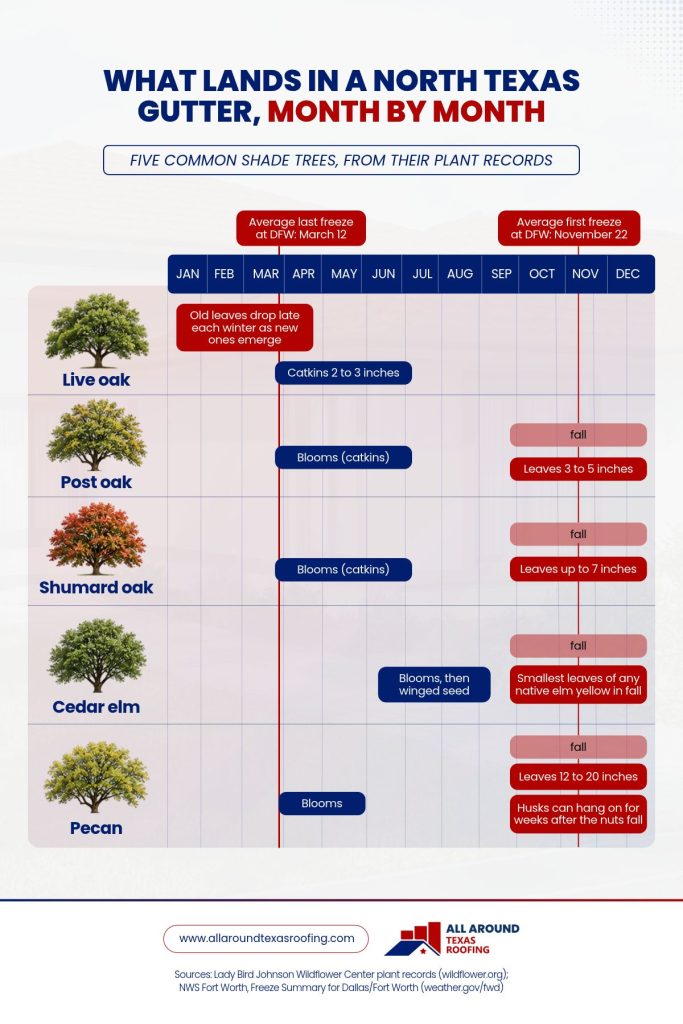
Start with the trees over your roof, not with a product brochure. The University of Texas Wildflower Center’s plant records show why. A pecan’s compound leaves run 12 to 20 inches. Post oak leaves run 3 to 5 inches. Cedar elm carries the smallest leaves of any native elm. Live oaks drop old leaves late each winter as new ones emerge, then hang 2 to 3 inch catkins in spring.
Big leaves are what basic screens are built for. Small leaves, catkins and seed call for a finer opening, which is what micro-mesh is sold to stop. Whatever you choose, it has to be fitted without lifting shingles and without leaving a gap at the roof edge. The Texas A&M Forest Service also wants leaves cleared from the first five feet around a home, gutters included, so a guard does not end the fall gutter check.
Why Does the Tree Overhead Matter More Than the Guard Brand?
The tree decides the size, shape and timing of what lands in the gutter, and every guard is a screen with a particular opening. A guard that sheds a seven inch oak leaf can still pass a cedar elm leaf, a catkin strand or a winged seed. So the first question on any McKinney roof is which trees overhang it, and when each one drops.
Most buying guides rank guards by brand. That is useful once you know your debris and close to useless before.
Picture three houses on one McKinney street: one under a pecan, one under a pair of planted live oaks, one with nothing taller than a crape myrtle near the eaves. Those three roofs need three different answers.
Shopping for gutter guards for leaves without naming the tree is how a house under a cedar elm ends up with a screen built for oak leaves.
Our own gutter guidance names oaks, pecans, and elms as the trees that make guards worth buying here, and singles out the older, tree-lined neighborhoods of McKinney, Frisco, and Celina. A newer street in Anna or Melissa with young trees drops less today than it will once those trees fill out, which is worth weighing before you choose.
What Each Common Tree Drops, and When
We pulled the plant records for the shade trees we see most often over Collin County roofs from the Lady Bird Johnson Wildflower Center’s entry for live oak and its matching entries for post oak, Shumard oak, cedar elm, and pecan. The table keeps to what those records say.
| Tree | Leaf | Other debris | When it lets go |
|---|---|---|---|
| Live oak | Dark green, waxy, unlobed | Catkins 2 to 3 inches long, acorns 1/3 to 1/2 inch | Old leaves last through winter as new ones emerge; blooms March to May |
| Post oak | 3 to 5 inches or longer, lobed | Catkins, acorns up to 3/4 inch | Deciduous, fall color; blooms March to May |
| Shumard oak | Up to 7 inches, pointed lobes | Catkins, acorns | Deciduous, often scarlet in fall; blooms March to May |
| Cedar elm | Small, rough, the smallest of any native elm | Winged seed (samara) | Deciduous, yellow in fall; blooms July to October |
| Pecan | Compound, 12 to 20 inches with 11 to 17 leaflets | Long male flower clusters, nuts in a husk | Deciduous; blooms March to May; husks can hang on for weeks after the nuts fall |
The live oak surprise
Live oaks look evergreen, so homeowners often assume they never fill a gutter. The Wildflower Center record says otherwise: the tree is deciduous and drops its old leaves late each winter, just as the new ones open. Then, in spring, it adds catkins.
A house under live oaks can have its worst gutter load of the year in February and April, when nobody is thinking about leaves.
Cedar elm, small and late
Cedar elm is the opposite problem. The leaves are small enough that the same record says there is no need to rake them off a lawn because they compost in place. That is good news for the yard. On a roof, small leaves and winged seed are exactly the debris that slips through a coarse screen and settles in the trough below it.
Pecan, big leaves and a long tail
A pecan leaf is a stem carrying a row of leaflets, and the whole thing can run longer than a gutter is wide. Leaflets break apart as they dry. Husks stay on the tree for weeks after the nuts fall, so a pecan keeps feeding a gutter well after the leaves are down.
Five Guard Styles We Fit, and What Each Is Built to Stop
Our gutter installation work includes five guard styles, and we describe each one by the debris it is meant for. That is the fairest way to compare them, because every style trades some filtering against how much it costs and how much attention it needs.
| Guard style | How we describe it | Where it fits |
|---|---|---|
| Stainless micro-mesh | Blocks the finest debris, including pine needles and shingle grit | Small leaves, catkins, seed, needles |
| Reverse-curve (surface tension) | Water follows the curve into the gutter while leaves are shed over the edge | Large leaves on a steady slope |
| Foam insert | Budget option for low-debris areas | Little or no tree cover |
| Perforated aluminum | Entry-level protection for lighter debris | Light, larger debris |
| Screen | Basic protection from large leaves and twigs | Big leaves, twigs |
Gutterglove, a guard manufacturer, describes its own micro-mesh the same way: fine mesh that keeps out pine needles, roof grit, and other tiny debris. We cite that to describe the product type, not to name a brand we fit. The brand on your roof is a quote conversation.
Which Gutter Guard Works Best for Small Leaves and Catkins?
For cedar elm leaves, oak catkins, pecan flower strands, and winged seed, a fine opening is the one that keeps them out of the trough. Of the five styles, stainless micro-mesh is the one described as blocking the finest debris. Screens and perforated aluminum are described for larger leaves and lighter loads, so small debris is what they are least suited to.
Here is how we read the match when we stand in a yard and look up.
| What is overhead | First style we would price | Why |
|---|---|---|
| Cedar elm, or several oaks that flower in spring | Micro-mesh | Small leaves, catkins, and seed are fine debris |
| Pecan | Micro-mesh, or a reverse-curve on a long, even roof edge | Big leaves plus husks and flower strands |
| Post or Shumard oak only, set back from the house | Screen or perforated, priced against micro-mesh | Mostly large lobed leaves |
| Mixed trees, including a pine | Micro-mesh | Needles are the finest common debris |
| No trees within reach of the roof | Foam, or no guard and a twice-yearly cleaning | Low debris |
That table is a starting point, not a verdict.
It is also where most of the money in a guard decision goes, so it is worth slowing down on. Roof pitch, the gutter size, and how far the branches reach all move the answer, and we would rather tell you a guard is not worth it than sell one a yard does not need.
What small debris does to a coarse guard
A screen does not fail all at once. Small leaves and seed get through, settle on the floor of the gutter, and stay wet under the screen. Our gutter repair notes put it bluntly: a guard that clogs is worse than no guard, because the blockage is now under a lid where nobody sees it.
Where a Guard Install Goes Wrong at the Roof Edge
Plenty of guard trouble traces back to the fitting rather than the product. Gutterglove’s own list of signs a gutter guard was installed the wrong way reads like a checklist for a homeowner standing in the yard after the first heavy rain.
- Water still sheets over the front edge in rain, which it says points to guards misaligned, set at the wrong angle, or a poor product.
- The gutter looks like it is pulling away, which it ties to guards fitted without proper support or with the wrong fasteners.
- Puddles or erosion along the foundation, because a guard only works if the downspouts carry the water away.
- Daylight between the roof and the guard, which lets leaves and needles straight back in.
- Shingles lifted or damaged, because some guards tuck under the shingles and a rushed fit can open the door to leaks.
The fifth point is the one a roofer cares about most. Gutterglove says plainly that shingles should not be lifted or damaged during a guard install. Some guards slide under the first course of shingles and some fasten to the gutter lip and fascia. Ask which method a quote uses and what it does to the shingle edge before you sign.
The third point is the same water problem covered in where the downspout below the guard should drain on clay soil. A guard that keeps leaves out of the gutter still hands every gallon to the downspout, and on the clay under most Collin County slabs, the place that water lands matters.
If a guard has already pulled a run loose or bent a hanger, the work is repairing gutters a bad guard fit has pulled off the fascia before anything new goes on top.
The Five-Foot Zone the Texas A&M Forest Service Asks You to Clear
The state forestry agency treats leaves in gutters as fuel. In its guidance on what to do with fallen leaves, the Texas A&M Forest Service says embers are the leading cause of homes destroyed by wildfires and that embers can gather where leaves have fallen around a home. Its Firewise coordinator asks homeowners to clear debris from zero to five feet out, and names gutters first in that zone. The same article recommends leaving leaves in the yard, away from the house, as mulch that feeds the soil. So the advice is not to rake everything. It is to keep the first five feet, roof edge included, clear, which fits what the Wildflower Center says about cedar elm leaves composting on a lawn.
Lawn: fine. Gutter: no.
A guard helps with that zone, and it does not end the job.
Leaves pile on top of some guard styles and against the roof edge above them, and they still need to come off in a dry fall. The agency also notes that leaves keep falling across Texas into the Christmas season, so the clean gutter in late October is not the clean gutter in late December.
Timing a Guard Around McKinney’s Leaf Drop and First Freeze
The National Weather Service office in Fort Worth puts the average first freeze at DFW on November 22 and the average last freeze on March 12, in its freeze summary for Dallas and Fort Worth.
Those two dates frame the guard decision better than the calendar on a brochure.
| Window | What is falling | What we would do |
|---|---|---|
| Late October to the first freeze | Deciduous oak, pecan and cedar elm leaves | Clean the gutters, then look at what came out |
| November 22 to Christmas | Leaves still coming down | A second pass on the gutters if the trees are close |
| Late winter, near March 12 | Live oak leaf drop as new leaves open | Have any guard fitted before this if live oaks overhang the roof |
| March to May | Oak and pecan catkins and flowers | First real test of a fine guard |
| July to October | Cedar elm flowers and seed | Check for seed under coarse guards |
If your gutters fill with large fall leaves, the guard can go on after the fall cleaning. If live oaks overhang the house, get it fitted before late winter, because that is when those trees drop. Our roof maintenance calendar built on Collin County’s storm record already places a gutter check in the fall window, and a guard decision fits neatly into that visit.
Do Gutters With Guards Still Need Cleaning?
Yes, less often, and the work changes. A guard cuts down the debris reaching the gutter, and it does not take the gutter off the maintenance list. Fine sediment and roof grit still get into most systems, leaves still collect on top of some styles, and the downspout outlets still need a check after a heavy drop.
Here is what we check on a guarded gutter.
- Leaves and seed matted on top of a mesh, which can shed rain over the front edge
- Water spilling at one corner during rain, often an inside miter or a loose section
- Lifted or scuffed shingles along the roof edge where the guard meets the roof
None of that needs a ladder. A walk around the house in a steady rain shows most of it.
Questions to Ask on a McKinney Gutter Guard Quote
Bring the tree names to the conversation. A quote that never asks what grows over your roof is pricing a product, not your house.
- Which trees overhang each run, and which style do you suggest for each side of the house?
- Does this guard slide under the shingles or fasten to the gutter and fascia, and what happens to the shingle edge?
- How does the guard handle the inside corners and the downspout outlets?
- What maintenance does this style still need, and how would I see that it needs it?
- Are the existing hangers and fascia sound enough to carry a guard, or does something need fixing first?
Two more points are worth knowing. A guard is only as good as the gutter under it, so a sagging run or a rotted fascia board gets fixed before anything goes on top. And a guard is not the right buy for every house. Where nothing overhangs the roof, two cleanings a year can be cheaper than any guard.
Bring Your Tree List to a McKinney Gutter Guard Visit
Before anyone measures a gutter, walk the house and name the trees: live oak, pecan, cedar elm, post oak, anything with needles. Note which side of the roof each one hangs over and when you last pulled leaves or catkins out of that run. That short list does more to pick the right guard than any product ranking.
When you are ready, All Around Texas Roofing will look at the trees, the roof edge, and the gutters together, across McKinney, Prosper, Anna, Melissa, and the rest of the towns in our roof and exterior work across McKinney and Collin County.
If the right answer is a fine mesh on one side and nothing on the other, that is what we will tell you.