 info@allaroundtexasroofing.com
 Schedule Now
 (469) 598-0899
A roof in Prosper, McKinney, or Melissa needs two planned checks a year, one in spring after the last freeze and one in fall before the first, plus a look after every hailstorm. The timing matters more than most checklists admit. Five years of weather service reports show Collin County’s hail does not stop when spring ends, and a fall check is how you catch the storms nobody remembers.
TL;DR
Prosper roof maintenance, and the same routine anywhere in Collin County, comes down to three habits. First, a spring check after the average last freeze (March 12 at DFW) to find what winter and the early storms did. Second, a fall check before the average first freeze (November 22) with the gutters cleared. Third, a look after any hail, whatever the month.
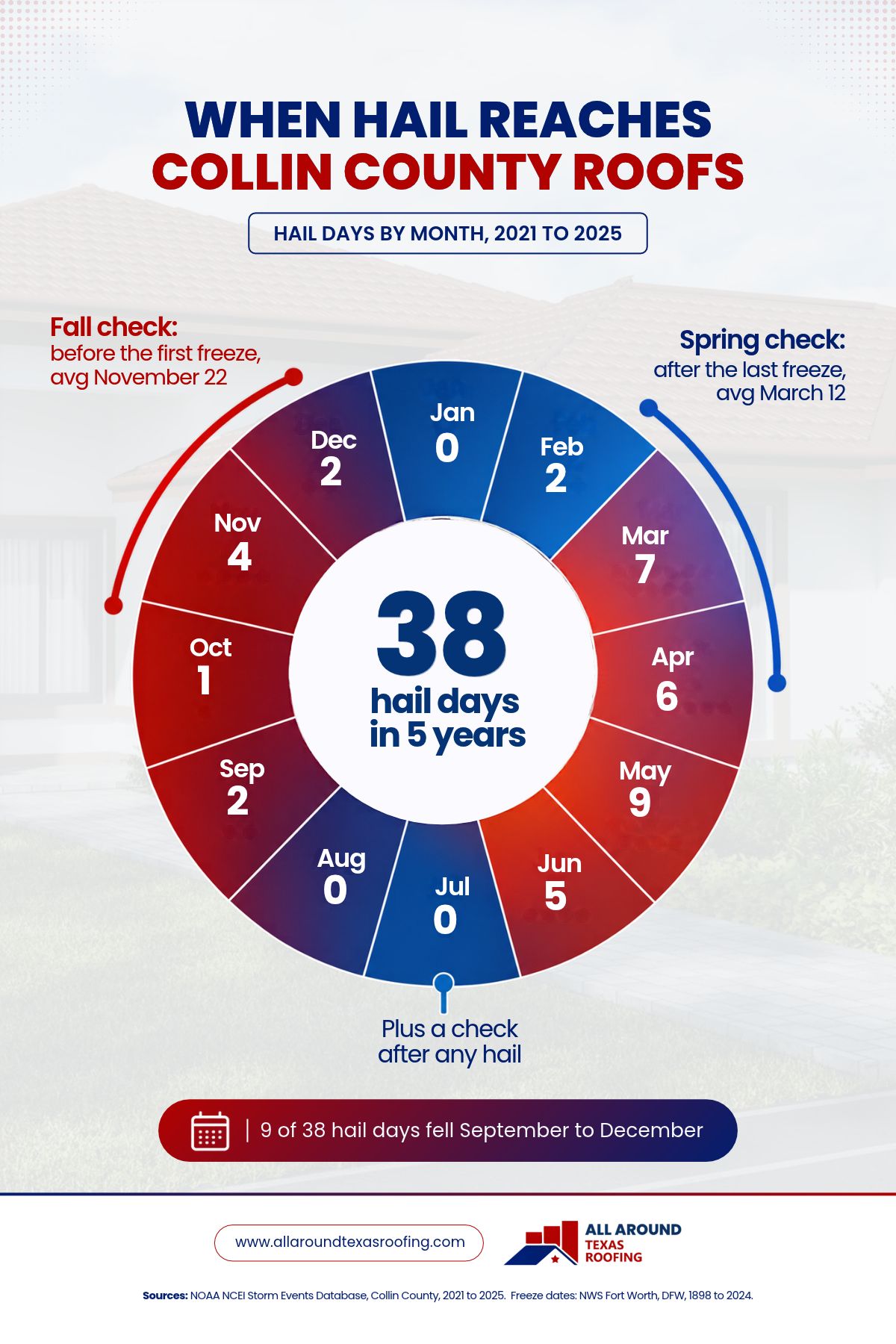
Between 2021 and 2025, the county logged hail on 38 separate days, and 9 of those fell between September and December, including hail at Anna and Melissa in September 2025 and at McKinney in November 2025. Homeowners should look from the ground or a braced ladder, never from the roof itself. Loose flashing, cracked shingles, granules in the gutters, and stains on a ceiling are the signs that turn maintenance into a repair.
How Often Does a Roof in Prosper or McKinney Need Maintenance?
A shingle roof in Prosper or McKinney needs a planned check twice a year, in spring and in fall, and an extra one after any storm that brings hail or strong wind. That is the schedule the National Roofing Contractors Association gives homeowners, and North Texas weather gives it a local reason.
The NRCA’s homeowner guidance on maintenance is blunt about what a homeowner should do personally. It limits do-it-yourself maintenance to looking at the roof in fall and spring for cracked or curling shingles, and to cleaning gutters of leaves and debris. Everything else, it says, is work for a professional roofer.
Here is how that schedule looks on a Collin County calendar.
| Check | When | Why then |
|---|---|---|
| Spring | Mid-March to April | After the last freeze, before the heaviest hail month |
| Early summer | June, after the storm run | Only if hail or high wind hit your street |
| Fall | October to mid-November | After leaf drop starts, before the first freeze |
| Storm | Within a few days of any hail | Hail has fallen in nine different months here |
Most homeowners do the spring check if they do anything. The fall check is the one that gets skipped, and the storm record below is the argument for it.
What Five Years of Collin County Storm Reports Say About Timing
We counted every hail report the National Weather Service logged for Collin County from 2021 through 2025, using the bulk files in NOAA’s Storm Events Database. A “hail day” here is a calendar date with at least one hail report anywhere in the county.
| Month | Hail days | Hail reports | Thunderstorm wind days |
|---|---|---|---|
| January | 0 | 0 | 0 |
| February | 2 | 10 | 1 |
| March | 7 | 35 | 6 |
| April | 6 | 17 | 4 |
| May | 9 | 48 | 5 |
| June | 5 | 20 | 2 |
| July | 0 | 0 | 1 |
| August | 0 | 0 | 2 |
| September | 2 | 12 | 2 |
| October | 1 | 1 | 0 |
| November | 4 | 5 | 2 |
| December | 2 | 2 | 0 |
| Five years | 38 | 150 | 25 |
March through June carried 27 of the 38 hail days in the NOAA files. That is the season everyone plans around, and it is why the spring check sits in March and April.
The part that surprises people is the other end of the year. Nine of the 38 hail days, about a quarter, fell between September and December.
The autumn storms people forget
Those fall storms were not all somewhere else in the county. The same NOAA files record hail near Anna and Melissa on September 21, 2025, with a 2-inch stone logged at Melissa. McKinney logged hail on November 24, 2025, and Prosper on December 16, 2024.
A storm like that in late September arrives when nobody is thinking about roofs. The spring claims season is long over, the yard is dry and brown, and a few dented vents are easy to miss from the driveway. By the time a ceiling shows a stain, it can be months later and much harder to tie back to one storm.
Wind deserves its own line. The same files show 25 thunderstorm wind days in five years, and the earlier study we ran on these records found Collin County logged 30 wind reports in 2025 alone, as many as the four years before it combined. Wind lifts shingle tabs and breaks their seal without leaving the round marks hail does, which is why a lifted edge along the ridge belongs on every check, not only the spring one.
One caution on the numbers. A report exists because someone saw the storm and reported it, so busy areas and places with weather spotters log more. The counts show when hail reaches the county. They cannot tell you how often it hit your particular street.
The Spring Check, After the Last Freeze
The National Weather Service’s Fort Worth office puts the average last freeze at DFW on March 12, across a record running from 1898 to 2024. That is a sensible starting line for the spring check in Prosper, Celina, and McKinney. Winter is mostly done, and the busiest hail months are still ahead.
What we want you to look at, from the ground or a braced ladder:
- Shingles that are cracked, curled, lifted, or missing, especially along ridges and roof edges
- Metal flashing around chimneys, walls, and skylights that has pulled away or rusted
- Vent caps and pipe boots that look split, dented, or loose
- Dark streaks of granules collecting at the bottom of downspouts
- Branches that now touch the roof after a winter of growth
- Any fresh stain on an upstairs ceiling or in a closet under the roof
Write down what you see and photograph it with the date. A dated spring photo of an undamaged roof is useful later if a May storm does real harm and you need to show the damage is new.
Spring is also when the attic tells you the most. After a wet winter, a flashlight on the underside of the deck will show dark rings or damp insulation around any leak, even one too slow to reach the ceiling.
The Fall Check, Before the First Freeze
The same weather service record puts the average first freeze at DFW on November 22. We treat the weeks before that date as the fall window: leaves are coming down, the autumn storms have had their turn, and anything that needs fixing can be done before the cold.
Our own gutter guidance is to clean twice a year, once in late spring after the oak catkins drop and again in late fall after the leaves are down. The fall cleaning matters more for the roof than it looks. A gutter packed with leaves overflows at the back edge, and that water runs behind it onto the fascia board.
It is a common failure on North Texas homes, Melissa and Anna included. The fascia behind a clogged gutter stays wet through every winter rain; the paint lets go first, and the wood softens behind it. Our post on soffit and fascia damage that homeowners miss covers what that rot looks like once it has started.
For the fall pass, add three things to the spring list:
- Clear the gutters and run a hose through each downspout to confirm it drains.
- Look closely at every vent, gutter, and metal cap for small round dents, the kind a September or November storm leaves behind.
- Check that the attic still smells dry after the first cool, wet week.
After Any Hail, Whatever the Month
Nine different months carried hail in the Collin County record, so a storm check cannot wait for the next scheduled pass. Within a few days of any hail, work through this from the ground:
- Look at soft metal first: gutters, downspouts, vent caps, and the air conditioner fins. Fresh dents there are the easiest evidence that hail was big enough to matter.
- Photograph anything dented, cracked, or knocked loose, with the date.
- Check the ceilings and the attic, then again after the next rain.
- Stay off the roof. A storm-wet roof is a dangerous place to look for hail marks.
What Can a Homeowner Safely Check From the Ground?
A homeowner can safely check shingle edges, gutters, downspouts, visible flashing, vent caps, and the ceilings and attic inside the house, all from the ground, a braced ladder, or indoors. The NRCA says homeowners should stay on the ladder and off the roof if possible, using a ladder that is firmly braced or tied off, with rubber safety feet and rubber-soled shoes.
The same NRCA guidance lists what regular inspections tend to turn up:
| What to look for | Where you see it |
|---|---|
| Cracked, warped, or missing shingles | Roof edges, ridges, the slope facing the storm |
| Loose seams and deteriorated flashing | Chimneys, walls, skylights, valleys |
| Excess surface granules | Gutters and the ground below downspouts |
| Cracked paint and discolored drywall | Ceilings and walls under the roof |
Binoculars help more than a taller ladder. From the far side of the street, you can read a whole slope in a minute and never leave the ground.
What you cannot do from down there is judge whether a shingle has lost its seal, whether a soft spot in the deck is spreading, or whether small hail has bruised the mat. Those need someone on the roof with the right equipment. Our list of the signs a roof needs repair helps you decide when what you saw from the ground is worth a call.
What Prosper’s Re-Roof Rules Say About Vents, Flashing and Drip Edge
The Town of Prosper publishes a re-roof permit handout (revised April 2025) covering roof repair and replacement work. It reads like a list of the parts that fail first, which is exactly what a maintenance check should be watching.
Among the Town’s requirements:
- Drip edge is required on all asphalt shingle roofs.
- Damaged, rusted, or deteriorated roof vents and flashing must be replaced.
- Exhaust vents through the roof need proper termination, with dampers and screens, and clothes dryer vents must not have a screen.
- The final inspection includes the attic, where the inspector confirms vent piping goes through the roof and appliance vents are connected.
- New roofing has to meet the 2021 International Residential Code as the Town has adopted it.
Two of those items are worth watching between replacements. Rusted flashing and split vent boots are among the most common sources of small roof leaks, and the Town’s rule is a reminder that they get replaced, not patched over, when the roof is redone.
The dryer vent on a two-story home
The dryer vent line is the practitioner’s detail here. Some two-story homes around Prosper and Celina vent the dryer up through the roof, and because that cap has no screen, lint collects in the flap instead. A clogged roof cap slows the dryer and holds moist, warm air against the deck. If your dryer takes longer than it used to, look at the roof cap from the ground and ask about it at your next check.
Where Maintenance Stops and a Repair Starts
Maintenance is looking, cleaning, and catching small things early. Once something needs to be removed and replaced, it has become a repair, and on a roof that usually means someone working at height.
| You find | Maintenance or repair | Who handles it |
|---|---|---|
| Leaves and granules in the gutters | Maintenance | You, from a ladder |
| A branch touching the roof | Maintenance | You or a tree service |
| One lifted or cracked shingle | Repair | A roofer |
| Rusted or loose flashing | Repair | A roofer |
| A split pipe boot or dented vent cap | Repair | A roofer |
| A ceiling stain or wet insulation | Repair, and soon | A roofer first, then the interior |
The NRCA’s consumer bulletin on maintenance makes a point worth repeating here. It notes that manufacturer warranties often limit what the warrantor pays for, and argues that regular maintenance with a professional contractor protects a roof better than a warranty certificate does. We agree. A small flashing repair in April costs far less than the ceiling it would have ruined by June.
Does a Newer Home in Anna, Melissa or Celina Need It Too?
Yes. A newer roof in Anna, Melissa, or Celina needs the same two checks, because hail does not care how old the shingles are, and several of the fall storms in the NOAA record landed on exactly these fast-growing towns.
What changes is the target. On a young roof, you are looking for installation details, like a loose vent cap or a gutter that does not drain, rather than wear.
Book Your Fall Roof Maintenance Check Before the Freeze
If your last good look at the roof was in spring, the next one belongs between now and late November, before the first freeze and after the leaves have mostly come down. Clean the gutters, walk the property with your spring photos in hand, and look hard at the metal for small dents from any autumn storm.
When you want a second pair of eyes, our free roof inspection covers the shingles, flashing, vents, gutters, soffit, fascia, and attic, and comes with a photo report you can keep for next spring. Homeowners in Prosper can read more about the storms and neighborhoods we cover on our Prosper roofing page, and Melissa homeowners can read more on our Melissa page. For the spring side of the year, our storm season prep checklist covers the whole exterior. Or start with All Around Texas Roofing and tell us which town you are in.