 info@allaroundtexasroofing.com
 Schedule Now
 (469) 598-0899
After a hailstorm crosses Frisco, Prosper, or Celina, two letters tend to land in the same week: one from the insurance company approving a new roof, and one from the homeowners association reminding everyone that roof changes need approval. Most of the time, the two agree. When they do not, Texas law has already settled more of the argument than most homeowners realize.
TL;DR
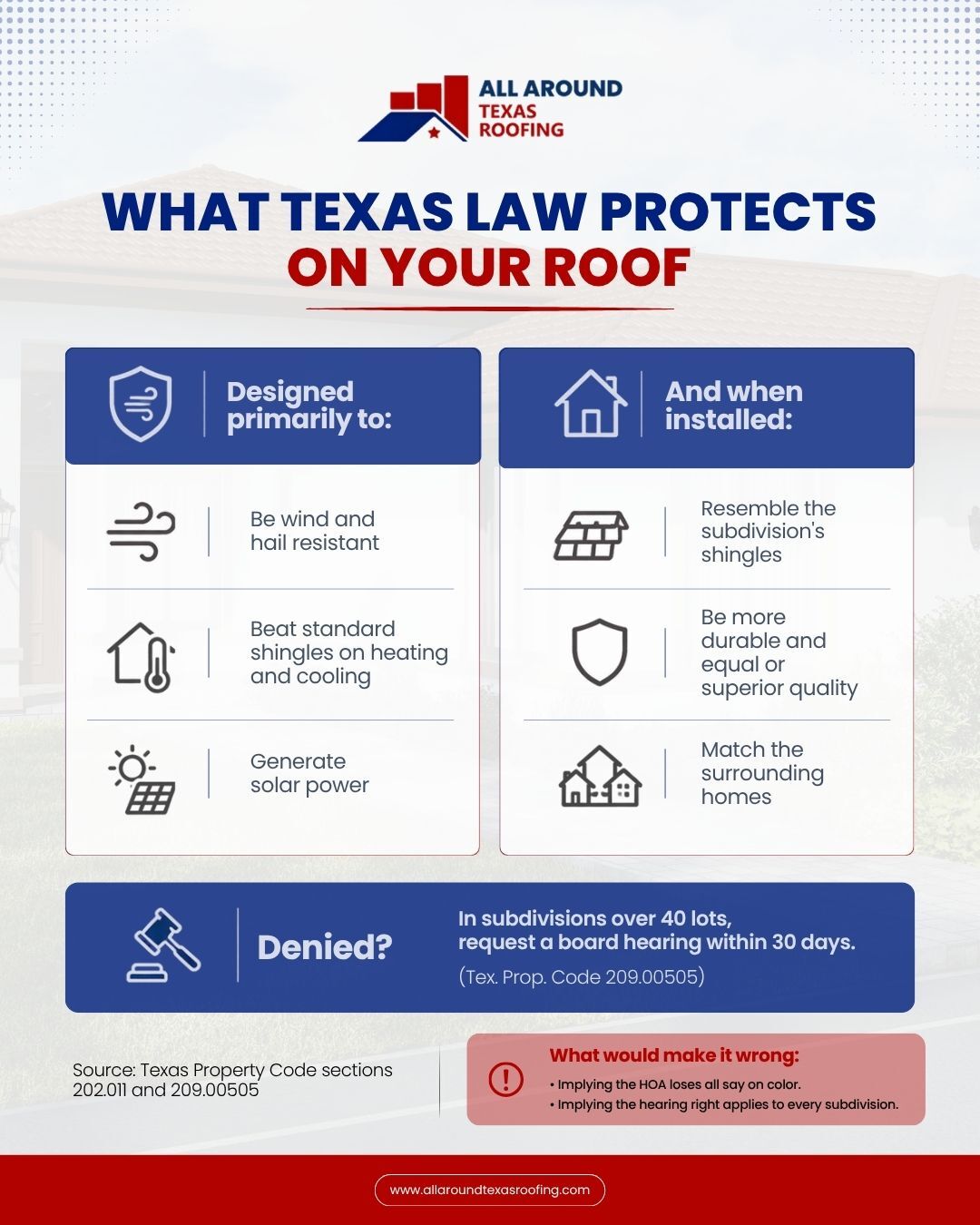
Texas Property Code section 202.011 says a property owners’ association may not prohibit or restrict a homeowner who is otherwise allowed to install shingles from installing shingles designed primarily to be wind- and hail-resistant, to outperform customary composite shingles on heating and cooling, or to generate solar power. The protection has conditions: the shingles must resemble those used or authorized in the subdivision, be more durable than and of equal or superior quality to them, and match the look of the surrounding properties. The association still controls color and appearance within those limits, and in larger subdivisions, a denial must be in writing and can be appealed to the board under section 209.00505. The practical route is a complete application that shows the product, the color, and why it meets the statute.
What Section 202.011 Actually Says
The law is one sentence long, with a list inside it, so it is worth reading exactly rather than secondhand. Texas Property Code section 202.011, titled “Regulation of Certain Roofing Materials”, says an association may not include or enforce a provision in a dedicatory instrument that prohibits or restricts a property owner who is otherwise authorized to install shingles from installing shingles that meet two tests.
The first test is about what the shingle is designed to do. It must be designed primarily to do one of three things.
| Protected purpose | In roofing terms |
|---|---|
| Be wind- and hail-resistant | Impact-resistant and high-wind-rated shingles |
| Beat customary composite shingles on heating and cooling | Reflective or “cool” shingles |
| Provide solar generation capabilities | Solar shingles |
The second test is about how the roof looks once installed. The shingles must:
- Resemble the shingles used or otherwise authorized for use in the subdivision
- Be more durable than, and of equal or superior quality to, those shingles
- Match the aesthetics of the property surrounding the owner’s property
The section was added by the Legislature in 2011 and took effect on 17 June of that year. A “dedicatory instrument” is the paperwork that governs the subdivision: the declaration, the deed restrictions, the bylaws, and the architectural guidelines.
Why “resemble” is the word that matters
Almost every disagreement over section 202.011 comes down to one word. The statute does not require the new shingle to be identical to the old one, only to resemble it and to match the surrounding properties. A committee that insists on one exact product name is asking for more than the law lets it enforce against a protected shingle. A homeowner who picks a bright color nobody else on the street has is asking for more than the law protects. The reasonable middle is a protected product in a color and profile a neighbor would not notice from the sidewalk.
Who Does the Law Protect, Exactly?
Section 202.011 protects a homeowner who is already allowed to install shingles and wants to install a better-performing version of them. It does not force an association that only permits tile to accept shingles, and it does not override the association’s say on appearance. It stops the association from banning the upgraded product itself.
That distinction matters. The phrase “otherwise authorized to install shingles” means the statute works inside the existing rules. Where a subdivision allows asphalt shingles, an impact-resistant asphalt shingle in a matching color is squarely what the law protects.
What the law does not do:
- It does not let you pick any color you like
- It does not let you switch roof types, shingle to metal, for example, on the strength of this section alone
- It does not remove the need to apply for approval if your guidelines require one
- It does not cover products that are not designed primarily for one of the three purposes
Metal roofing is a good example of the last point. A metal roof may well be hail- and wind-resistant, but it is not a shingle that resembles the neighborhood’s shingles, so section 202.011 is unlikely to help if your guidelines exclude it. We cover the trade-offs between the two in our comparison of metal and shingle roofs in Texas.
What Your Association Can Still Decide
Plenty. The statute removes one argument from the table, the “we do not allow that product” argument, and leaves the rest in place.
The architectural review committee can still decide:
| Still the association’s call | Why |
|---|---|
| Color | The “resemble” and “match the aesthetics” conditions leave room for a color family or an approved list |
| Profile | A dimensional shingle among dimensional shingles resembles them; a flat three-tab look may not |
| Process | If your guidelines require an application before work starts, you still file one |
| Work rules | Hours, dumpster placement, and cleanup are separate from the material |
The honest reading is that the law protects the upgrade, not the owner’s taste. Most impact-resistant shingles on the market are made in the same colors and profiles as their standard versions, which is why the conditions are usually easy to meet.
Why This Comes Up After Every Hailstorm
Hail is the reason most Collin County homeowners think about impact-resistant shingles at all. When an insurance claim pays for a new roof, the homeowner is choosing a product anyway, and the upgrade costs less as a difference in price than it would as a separate project.
Research is pushing in the same direction. The Insurance Institute for Business and Home Safety runs the FORTIFIED Roof program, a voluntary construction standard. Its optional Hail Supplement requires shingles rated Good or Excellent on the institute’s own Hail Impact-Resistant Shingle Ratings, which it says outperform typical Class 4 shingles against realistic hailstones and better protect a home from hail up to 2 inches in diameter. The same standard requires the highest wind ratings for shingles, ASTM D3161 Class F or ASTM D7158 Class H.
Those are exactly the kinds of products the statute describes as “designed primarily to be wind and hail resistant”. The law and the building science point the same way.
A word on insurance
Some Texas insurers offer premium discounts for impact-resistant roofing. Whether yours does, and how much, depends on your carrier and policy, so ask your agent before choosing a product. Nothing in section 202.011 depends on a discount, and nothing about the discount depends on your HOA.
The Approval Packet That Gets a Yes
Most HOA roof disputes are not legal disputes at all. They are incomplete applications. A committee that receives a product name and nothing else will ask questions, and questions take a month.
Here is what we suggest including, in this order.
- The product name and line, exactly as the manufacturer lists it.
- The color name, with a manufacturer photo or a physical sample if the committee meets in person.
- A photo of the current roof and of two or three neighboring roofs, to show the color and profile resemble what is already there.
- The product’s ratings, such as its impact rating and wind classification, from the manufacturer’s own literature.
- A one-line reference to Texas Property Code section 202.011 if the product is impact resistant, cool, or solar. Keep the tone informational, not confrontational.
- Your contractor’s name, any city registration it needs, and the planned start date.
A committee that can see the new roof will look like the old one, only tougher, rarely has a reason to refuse.
If the product is a like-for-like replacement
Many architectural guidelines treat replacing a roof with the same product in the same color as maintenance rather than a change. Check yours. If it does, the application may be a formality or may not be required at all.
Solar and Cool Shingles Fall Under the Same Rule
Most of the conversation in North Texas is about hail, but the statute protects two other kinds of shingles on exactly the same terms.
Cool shingles use reflective granules so the roof absorbs less of the sun’s heat. On a house in Collin County that is a practical choice rather than a novelty. The National Weather Service puts the normal high at DFW Airport at 95.6 degrees in July and 95.8 in August, and a dark roof spends those afternoons soaking up heat. Modern cool shingles are made in darker shades than people expect, which makes the “resemble” condition easier to meet than it once was.
Solar shingles are the harder case. They generate power, so they are plainly within the protected purpose, but they look different from ordinary shingles on most products. The appearance conditions still apply, and a solar shingle that does not resemble the neighborhood’s roofs may not get the benefit of section 202.011.
Separate rules in section 202.010 of the same chapter deal with solar energy devices such as panels, and they have their own conditions. If you are weighing panels rather than solar shingles, read that section, not this one.
For most homeowners, the useful takeaway is simple. If the product you want is sold as impact-resistant, cool, or solar, and it comes in a color and profile that looks like your neighbors’ roofs, the association’s objection has to be about the look, not the product.
What If the Committee Says No?
If your architectural review committee denies a roof application, and your subdivision has more than 40 lots and is past its developer control period, Texas Property Code section 209.00505 gives you a written reason and a hearing before the board. The denial notice must explain the basis in reasonable detail, list any changes that would lead to approval, and tell you that you may request a hearing on or before the 30th day after it was mailed.
The board must then hold the hearing within 30 days of receiving your request and give you at least 10 days’ notice of the date. Either side may ask for one postponement of up to 10 days. The board can affirm, modify, or reverse the committee’s decision.
A few practical points about that process:
- Read the reason first. Very often the fix is a color change the committee listed in the notice.
- Bring the manufacturer’s literature, the photos of neighboring roofs, and the statute to the hearing.
- Keep it about the conditions: resemble, more durable, equal or superior quality, match the surroundings. That is the test the law sets.
This is general information about two statutes, not legal advice. If a dispute goes past the board hearing, talk to a lawyer who handles property owners’ association matters.
While you wait on a damaged roof
Do not let the approval process leave a damaged roof open to the weather. Temporary protection, like a tarp over an opening, is a separate matter from the permanent roof and is part of protecting the property after a loss.
Timing the Roof, the Claim and the Committee
The three clocks run at different speeds. The insurance policy likely sets a period to complete repairs if you want the held-back depreciation paid. The committee has its own meeting schedule. Material availability after a big storm adds a third delay.
So file with the committee early, ideally as soon as the claim is approved and you have chosen a product. There is no reason to wait for the insurer’s second check to start that paperwork.
Let Us Build Your HOA Roof Application With You
We replace roofs in HOA neighborhoods across Frisco, McKinney, Prosper, Celina, and the rest of Collin County, so we have seen what committees ask for. As part of our residential roofing services, we can help you gather the manufacturer literature and product ratings your committee will ask for, and plan the start date around the approval.
If you are in Prosper or Celina, our Prosper roofing page and Celina roofing page cover local details.
Call (469) 598-0899 to talk through your product choice, or start with All Around Texas Roofing online.