 info@allaroundtexasroofing.com
 Schedule Now
 (469) 598-0899
If you want the lowest upfront price and a roof that is easy to repair fast after a hail storm, asphalt shingles win. If you plan to stay in your home for 15 years or more and you care about energy bills and a roof that shrugs off wind, metal pays back over time. When homeowners weigh a metal vs shingle roof Texas decision, the right pick comes down to budget, how long you will live there, and how much heat and storm punishment your area takes. Metal costs more on day one but lasts two to three times longer and reflects summer heat. Shingles cost less, look traditional, and get repaired quickly when a North Texas storm rolls through, especially when reliable Roof Repair Services are available. Below, we break down cost, heat, lifespan, noise, and resale so you can match the roof to your home and not just to a sales pitch.
Which Roof Actually Fits a Texas Home?
The honest answer is that both work well here, and the best roof for Texas depends on your plans more than on which material is “better.” Texas weather throws three things at a roof: brutal summer heat, sudden hail, and high straight-line winds. Metal and quality asphalt shingles can both handle all three, but they handle them differently.
Pick shingles if you are watching the budget, you might move in under ten years, or your neighborhood has a traditional look you want to keep. Pick metal if you are staying put, you run the AC hard from May through September, or you are tired of replacing the same roof every dozen years. Plenty of homes around Frisco, McKinney, and Celina have one of each on the same street, and both hold up when they are installed right. The mistake is choosing based on price alone without thinking about how long you will own the place.
There is also a middle group of homeowners who do not fit cleanly into either camp. Maybe you plan to stay eight to twelve years, which sits right on the line. In that case, look at your roof’s current age, your attic’s summer temperatures, and whether your area has been hit by hail in the last few seasons. A home in a hail-prone pocket of Collin County with a roof already past its tenth birthday is a different decision than a newer build in a calmer micro-climate. The point is to weigh your own facts, not a neighbor’s anecdote.
How Much Do Metal and Shingle Roofs Cost in Texas?
Shingles cost less upfront, and metal costs more but spreads its value over a longer life. A standard three-tab or architectural asphalt shingle roof on an average Texas home usually lands in the low-to-mid range per square foot installed. A metal roof costs roughly two to three times more for the same house, depending on the panel type, gauge, and finish.
Here is where it gets interesting. Because metal lasts so much longer, the cost per year of service often comes out close, and sometimes metal wins. If a shingle roof needs replacing every 15 to 20 years and a metal roof lasts 40 to 50 years, you may pay for the shingle roof twice over that span. So the question is not just what does it cost today, but what does it cost over the years I will own this house.
A few things that move the price either way:
- Roof pitch and shape. Steep or cut-up roofs with many valleys, dormers, and hips cost more for both materials because they take longer to install and use more flashing.
- Panel and shingle grade. Standing seam metal costs more than exposed-fastener metal. Premium designer shingles cost more than basic ones.
- Tear-off and decking. If old layers have to come off or rotted decking needs replacing, both go up.
- Gauge and finish on metal. A thicker 24-gauge panel with a baked-on Kynar finish costs more than a thin 29-gauge panel, but it dents less and holds color longer.
- Insurance offsets. After storm damage, an approved claim can cover a large share of a replacement, which changes the math fast.
To make the trade-off concrete, picture a homeowner who buys a shingle roof for one price today. Twenty years from now, with material and labor inflation, that same roof costs noticeably more to replace the second time. The metal owner pays once and skips the second bill entirely. Over a 40-year window, the gap between “one metal roof” and “two or three shingle roofs plus repairs” is where metal quietly catches up and sometimes pulls ahead on total spend.
If a storm has already damaged your current roof, the comparison shifts because part of the bill may not be yours. Our team walks homeowners through that on our storm damage roof repair, since a covered claim can make the upgrade to metal more affordable than people expect.
Do Metal Roofs Lower Energy Bills in Texas Heat?
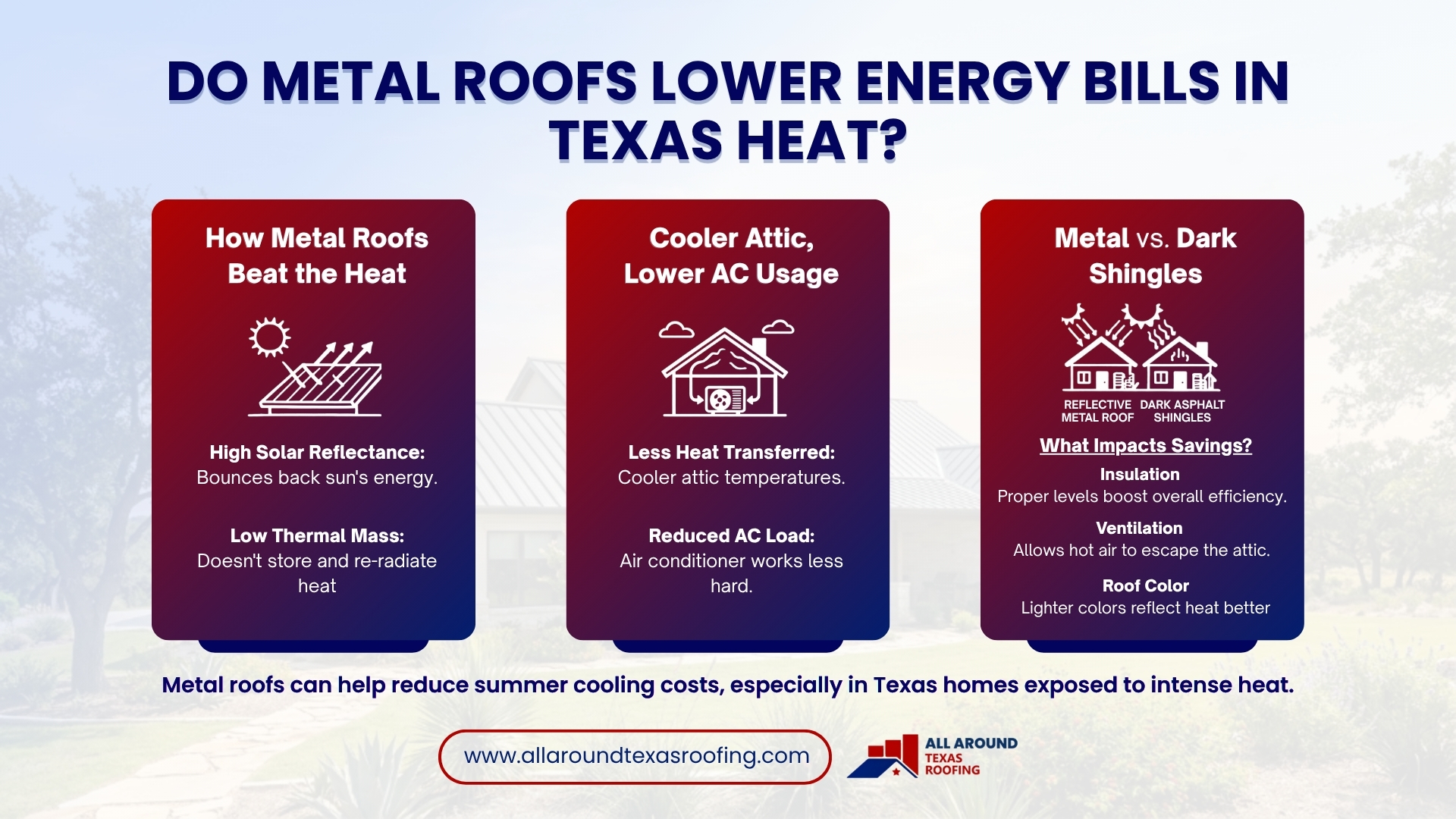
Yes, and this is one of the strongest points in metal’s favor for Texas summers. Metal roofs, especially ones with a reflective or “cool roof” finish, bounce a big share of the sun’s radiant heat back into the sky instead of soaking it into your attic. That keeps the attic cooler, which means your AC works less and your summer power bills can drop.
Dark asphalt shingles do the opposite. They absorb heat and hold it, which is why an attic under a black shingle roof can hit blistering temperatures on a July afternoon. You can get lighter-colored or specially coated shingles that reflect more heat, and those help, but they still trail a reflective metal panel on pure heat rejection.
How much you save depends on your attic insulation, ventilation, and how cool you keep the house. The savings are real but not magic, so treat them as one piece of the long-term value rather than the whole reason to switch. As a rough guide, a reflective metal roof can trim summer cooling costs by a noticeable share compared with a dark shingle roof, with the biggest gains in homes that run the AC long hours and have older, thinner attic insulation. A well-insulated, shaded home will see a smaller swing. Pairing either roof with good attic ventilation and clean gutters matters too. If your runoff is a mess, our gutter installation service keeps water moving away from the roof edge and fascia, which protects whichever material you choose.
Which Roof Survives Hail and Wind Better?
Metal generally handles wind better and dents from hail, while shingles can be torn or bruised but are far cheaper and faster to fix. That trade-off sits at the center of storm performance in Texas.
On wind, metal panels, especially standing seam, lock together and resist uplift very well in the high gusts that come with North Texas storm fronts. Architectural shingles are rated for strong winds, too, but individual tabs can lift or tear off in the worst gusts, and once a few go, water can get under the rest.
On hail, the story flips a little. Big hail can dent metal panels. The roof usually still works fine and keeps water out, but the dents are cosmetic, and some homeowners do not love the look. Hail can crack or knock the granules off shingles, which shortens their life and can lead to leaks. The upside for shingles is that a few damaged areas are cheap and quick to patch, while a dented metal panel often means replacing a whole section.
Hail size changes the calculus more than people expect. Pea-sized to quarter-sized hail rarely bothers metal and only lightly bruises good shingles. Once you get golf-ball or larger stones, the kind North Texas sees most springs, shingles can lose granules in sheets, while a thicker metal panel may shrug it off with only minor dimpling. If your area sees frequent large hail, impact-rated Class 4 shingles are worth pricing out, since they resist cracking better and can earn an insurance discount in many policies.
After any major storm, the smart move is a roof inspection before you decide anything, because damage is not always obvious from the ground. We cover what to look for in our guide to roof repairs after storm damage in Texas, and if you are dealing with an insurer, our North Texas roof insurance claim guide walks through filing the right way. Working with a contractor you trust right after storm damage keeps you from signing with a storm-chaser who disappears once the check clears.
How Long Does Each Roof Last?
Metal lasts much longer, plain and simple. A well-installed metal roof commonly lasts 40 to 70 years, depending on the metal and coating. A quality asphalt shingle roof in the Texas climate usually gives you 15 to 25 years, and the harsh sun and hail tend to push real-world life toward the lower end of that range.
That gap is the single biggest reason metal closes the cost difference over time. If you buy a house in your forties and plan to stay, a metal roof might be the last roof you ever buy. Shingles will likely need at least one full replacement in that same window, plus repairs along the way.
That said, longevity only counts if the install is right. A cheap metal install with poor fasteners or flashing can leak and fail early, and a rushed shingle job can lose tabs in the first big wind. The material matters less than the crew putting it on. Maintenance also stretches the number: clearing debris from valleys, keeping gutters open, and replacing worn pipe-boot seals every few years prevents the small leaks that cut a roof’s life short. Whether you are looking at roofing in McKinney or roofing in Celina, ask about workmanship warranties, not just the manufacturer’s material warranty.
Noise, Looks, and Resale: What Changes With Each Roof
Here is where personal taste and home value come into the picture, and the differences are smaller than most people think.
Noise: The old story that metal roofs are loud in the rain is mostly outdated. Modern metal roofs go over solid decking and underlayment, so the sound of rain and hail is close to that of a shingle roof inside the house. You may notice a bit more during heavy hail, but it is not the tin-shed racket people imagine. Adding a layer of foam or a synthetic underlayment quiets it even further if you are sensitive to sound.
Looks: Shingles give the classic, expected look that blends into most Texas neighborhoods, and they come in many colors, including popular greys and woodland grey tones that suit a lot of homes. Metal has come a long way and now comes in standing seam profiles and even metal shingles and tiles that mimic other materials. It is a more modern look that some buyers love, and a few do not. Worth checking before you commit: some HOAs in master-planned communities around Frisco and Celina restrict panel styles or colors, so confirm the rules before you fall in love with a profile.
Resale: Both can boost resale, but they appeal to different buyers. A new shingle roof is a clean selling point because buyers know it, and it is easy to value. Metal can command a premium with buyers who want low maintenance and energy savings, though in a very traditional neighborhood, it can be a wash. If you are selling soon, a fresh, well-installed shingle roof is the safe, broadly appealing choice. If you are staying, metal’s long life and lower upkeep are worth more to you than to a future buyer.
One more honest note on shingle roof pros and cons: shingles are cheaper, easy to repair, and familiar, but they wear faster in Texas heat and need replacing sooner. Metal flips that, costing more upfront but lasting longer with less hassle. Neither is wrong. They just fit different owners.
Here is a quick side-by-side to keep the trade-offs straight:
| Factor | Asphalt shingle | Metal |
| Upfront cost | Lower | Two to three times higher |
| Lifespan in Texas | 15 to 25 years | 40 to 70 years |
| Summer heat | Absorbs more | Reflects more |
| Hail | Cracks, loses granules | Dents but stays watertight |
| Wind | Tabs can lift | Strong uplift resistance |
| Repair | Cheap and fast | Section replacement |
| Best fit | Short-term owners, tight budget | Long-term owners, high AC use |
Picking the Roof That Matches your Home and your Timeline
The roof that fits you depends on how long you are staying, how hard your AC runs, and how your budget looks today versus over the next few decades. If you are still unsure after weighing cost, heat, lifespan, and resale, the best next step is an inspection of your actual roof so the advice fits your house and not a generic average. At All Around Texas Roofing, we will look at your roof, your attic, and any storm damage, then lay out honest options for both materials so you can choose with real numbers. Whether it ends up metal or shingle, the install quality is what keeps it over your head for the long haul.