 info@allaroundtexasroofing.com
 Schedule Now
 (469) 598-0899
Every square foot of your roof sends its rain somewhere, and on a North Texas house that somewhere is usually four or five spots along the foundation. The gutters collect the water. The downspouts decide where it lands. On the clay under McKinney, Frisco, and most of Collin County, that decision matters more than the gutter itself.
TL;DR
A downspout’s job is to move roof water far enough from the house that the soil under the slab stays evenly moist. North Texas sits on expansive clay that swells when wet and shrinks when dry, so a downspout emptying against one corner of the foundation can make that corner behave differently from the rest. The residential building code requires roof drainage to discharge at least 5 feet from foundation walls where expansive soils are known to exist, or into an approved drainage system. In practice, that means extensions, splash blocks, or buried drains, and enough downspouts that none of them is overloaded. On acreage lots with no street drainage, the water also has to leave your property without flooding a neighbor, which Texas law addresses directly.
Why the Ground Here Changes the Answer
In most of the country, a downspout that dumps water beside the house is a nuisance. It erodes a flower bed, maybe puddles near the door. Here it can move a house.
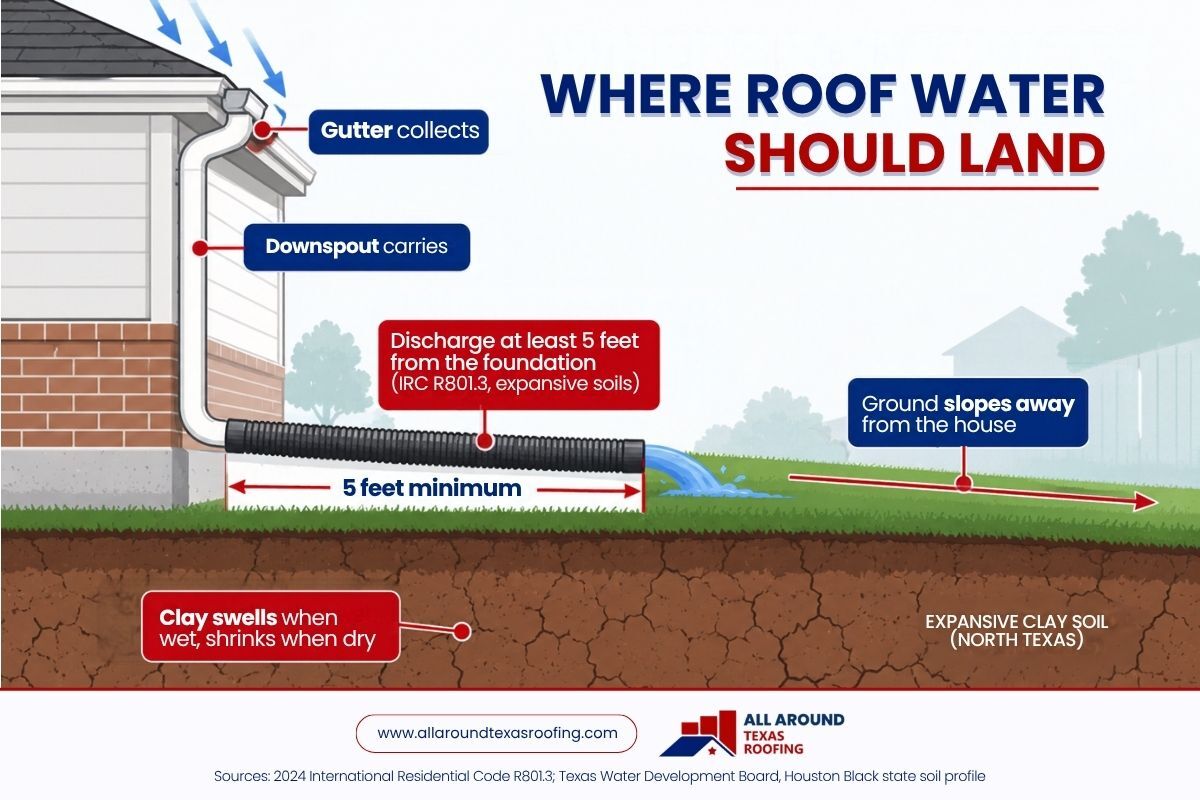
The Texas Water Development Board’s profile of Houston Black clay, the Texas state soil, describes it as the classic example of soils that “shrink and swell markedly with changes in moisture content”. It covers about 1.5 million acres of the Blackland Prairie, which the same profile says extends from north of Dallas south to San Antonio. The board notes that in metropolitan areas its very high shrink-swell potential is commonly a limitation for building sites.
That is the ground under a great many homes in Collin County.
The board also describes how the soil takes on water: rapidly when it is dry and cracked, and very slowly when it is moist. Picture what that means in August, when the clay around your slab has shrunk and opened cracks.
A storm arrives, and the roof sheds a large volume of water in an hour. A downspout pours all of it into those cracks at one corner. That corner swells. The opposite corner, which got nothing, does not.
Foundations tolerate even movement far better than uneven movement. The downspout is where the unevenness starts.
What the Code Says About Downspout Discharge
The residential code has a specific rule for exactly this situation, and it is short enough to quote in full. Section R801.3 of the 2024 International Residential Code says that where expansive soils are known to exist, dwellings “shall have a controlled method of water disposal from roofs that will collect and discharge roof drainage to the ground surface not less than 5 feet (1524 mm) from foundation walls or to an approved drainage system.”
Two ways to comply, then:
- Put the water on the ground at least 5 feet out.
- Put it into an approved drainage system.
Cities adopt the code with local amendments, and North Texas cities are not all on the same edition. McKinney, for one, moved to the 2024 codes in October 2025. Whatever edition your city uses, on Blackland clay the rule is simply good sense.
Five feet is a minimum, not a target
Five feet gets the water past the soil directly under the slab edge. It does not guarantee the water keeps going. If the ground at the end of the extension slopes back toward the house, the water returns. Grading matters as much as length, and a 5-foot extension that empties into a low spot has only moved the problem.
How Many Downspouts Does a Roof Need?
A roof needs enough downspouts that none of them carries more water than it can move in a hard storm, which depends on how much roof area drains to each one and how long the gutter run feeding it is. A long run with a single downspout at one end is the most common layout we see failing.
When one downspout is overloaded, three things go wrong at once. The gutter overflows at the far end, dumping water right against the foundation. The downspout that does work delivers a concentrated flood to one spot. And the fascia behind the overflowing section stays wet, which is how fascia rot starts, as we explain in our piece on soffit and fascia storm damage.
Signs a roof needs more downspouts, or bigger ones:
- Water sheeting over the front lip of the gutter during storms, even when the gutter is clean
- A worn line or splash marks on the ground directly under one section of gutter
- One downspout roaring while another barely runs
- Valleys that pour onto a gutter section with no downspout nearby
Valleys change the math
A roof valley funnels two planes of roof into one narrow stream. Where that stream hits the gutter, the gutter sees far more water than the rest of the run. A downspout near the bottom of a major valley is often the single most useful change on a house.
Extensions, Splash Blocks and Buried Drains Compared
There are only a handful of ways to get water from the bottom of a downspout to somewhere safe. Each has a place.
| Option | How it works | Best for | Watch out for |
|---|---|---|---|
| Splash block | Concrete or plastic tray under the outlet | Spots where the ground already falls away from the house | Does not reach 5 feet on its own |
| Hinged or flexible extension | A length of pipe that flips up for mowing | Side yards and beds | Gets knocked off or left up |
| Buried drain to a pop-up emitter | Solid pipe underground to an outlet in the yard | Front elevations, lawns, long distances | Needs a cleanout and correct fall |
| Buried drain to the street or a swale | Solid pipe to an approved discharge point | Lots with a curb or a drainage easement | Local rules on curb cores and easements |
| Rain barrel | Stores the first part of a storm | Gardens | Overflows in a real storm, so it still needs a route away |
What goes wrong with buried drains
A buried drain is the neatest answer and the one most often done badly. The pipe needs a steady fall along its whole length, or water sits in it.
It also needs to be solid pipe rather than perforated pipe next to the foundation, or it leaks water exactly where you did not want it. And it needs a cleanout, because granules washed off the roof collect in the low points.
Granules in the drain are also a clue. A buried line that fills with grit quickly is telling you the shingles are shedding, which is worth a look at the roof itself.
Acreage Lots in Pilot Point, Blue Ridge and Lowry Crossing
Out past the edge of the suburbs, the problem changes shape. Plenty of homes around Pilot Point, Blue Ridge and Lowry Crossing sit on larger lots with no curb and no storm sewer. There is nowhere official to send the water, so it has to go somewhere on your own land.
That usually means a longer buried run to a swale, a dry creek bed, or a low corner of the property well away from the house. The same code rule applies: at least 5 feet from the foundation, and further is better where the land allows it.
Your neighbor’s side of the fence
On a large lot it is tempting to send everything toward the property line. Texas law has something to say about that. Texas Water Code section 11.086 states that no person may divert or impound the natural flow of surface waters “in a manner that damages the property of another by the overflow of the water diverted or impounded”, and gives the injured neighbor remedies, including damages.
Downspout water is part of how your lot sheds rain. Collecting it from a whole roof and discharging it in one place at the fence line is a change to that flow. Aim the outlets so the water follows the way your land already drains, not toward the house next door.
Placing Downspouts Around a Typical Collin County House
Most homes built in Frisco, Prosper, Celina, and McKinney over the last twenty years share a layout: a front elevation facing the street, narrow side yards with a fence line close to the wall, a back patio, and often a garage roof that drains toward the driveway. Each side asks for a different answer.
The front: This is where buried drains earn their cost. An extension across a front bed looks untidy and gets kicked aside. A solid pipe run under the lawn to a pop-up emitter keeps the water moving and keeps the elevation clean.
The side yards: Five feet is often the whole width of the side yard, and the fence is right there. A downspout here usually needs to turn and run along the side yard toward the front or back before it discharges, rather than straight out toward the fence.
The back patio: A slab patio poured against the house can channel water straight back to the foundation. A downspout that empties onto the patio is sending water to the one place the patio cannot drain it away from.
Over the driveway: Concrete sheds water well, so a garage downspout that reaches the driveway and follows its slope to the street is often the easiest one on the house to get right.
None of these calls is fixed. They depend on how your lot is graded, and grading on newer Collin County lots was set by the builder for drainage in the first place. Work with it, not against it.
Signs Your Downspouts Are Working Against You
Most drainage problems show up outside long before they show up in the foundation. Walk the house after the next real storm and look for these.
| What you see | What it usually means |
|---|---|
| Soil washed away under an outlet | Water landing too close, with too much force |
| Standing water near the slab a day after rain | Grade falling toward the house, or an extension that ends in a low spot |
| Gaps between the soil and the slab in summer | Clay shrinking where it dried out, often on the side with no downspout |
| Doors that stick in one season and not another | Seasonal movement, often uneven moisture around the foundation |
| Cracks in brick above one corner | Worth having looked at, and worth checking what drains to that corner |
| Grit filling a buried drain | Shingle granules washing off the roof |
None of these proves a downspout caused a problem. Foundations move for many reasons. What they tell you is where to look first, and the downspout is the cheapest thing on the list to change.
Gutters, Downspouts and the Roof as One System
We think about downspouts when we look at a roof, because the three pieces fail together. A roof with worn shingles sheds granules that clog the gutters, and clogged gutters overflow onto the fascia.
Overflowing gutters and undersized downspouts then drop water against the slab. Fixing one piece and ignoring the others tends to move the problem around rather than solve it.
A good quote for gutter installation includes the downspout plan: how many, where, and where each one sends its water. If a quote only prices the gutter by the foot, ask for the rest. That conversation is also a good time to check the roof above, which is part of why fall is a sensible season for it. Our storm season roof prep checklist covers the roof side before spring.
Gutter questions are some of the most common we get from Melissa and McKinney homeowners in particular. If you are in Melissa, our Melissa roofing page covers the local details.
Have Us Walk Your Downspouts and Drainage
If you are not sure where your roof water goes, the fastest way to find out is to watch it in a storm, or to have someone walk the house who knows what to look for. We work across Collin and Denton County, from Frisco and McKinney out to Anna, Melissa, Pilot Point, and Blue Ridge.
Ask us to look at the gutters, the downspouts, where each one discharges, and how the ground falls, and we will tell you plainly what, if anything, needs to change. Sometimes the answer is a simple extension.
Call (469) 598-0899, or start with All Around Texas Roofing online.