
Lowry Crossing’s Roofing & Storm Damage Specialists
All Around Texas Roofing provides roofing and storm damage restoration in Lowry Crossing, Texas, between McKinney and Princeton on the US 380 corridor. Roof repair, full replacement, hail and wind damage, gutters, siding, windows, fencing and insurance claim documentation.
There is one thing about Lowry Crossing that almost nobody arriving to quote your job will mention, and it can cost you. The city permits more than you expect, including several of the things a hailstorm damages most.
Call (469) 598-0899 for a free roof inspection in Lowry Crossing, TX.
A town that incorporated so it would not be swallowed
Lowry Crossing has a genuinely good story, and it explains why the place feels the way it does.
The community takes its name from William L. Lowry, a Methodist circuit riding preacher whose family came to Texas from Kentucky in 1852 and settled near the East Fork of the Trinity River. Freight wagons crossed on his property, and the spot became known as Lowry’s Crossing. By the turn of the century it had two churches, a grist mill, three general stores, a blacksmith and a post office.
In 1971, residents became concerned the area would be taken over by McKinney or Princeton, both of whose boundaries were encroaching. They petitioned the Commissioners Court, and on 19 July 1971 Lowry Crossing incorporated as its own town. There were 79 families living here then. Today the city puts the population at about 2,380.
For a roofing contractor that history explains the housing: a mix of long standing properties on larger lots and newer building, rather than one uniform subdivision.

Weather risks for Lowry Crossing homes:
Larger lots change the picture. Less shelter from neighboring structures means more exposure to wind, and mature trees near a roof mean limb impact damage, more debris in the valleys and gutters, and overhanging branches that abrade shingles over time.
Schedule a free inspection and we will include the tree and limb work in the scope where it is part of the problem, rather than leaving it for you to arrange separately.
Several of these are separately permitted in this city, which is noted where it applies.
One contract, one crew sequencing the work, one set of photographs behind the claim, and the applications handled rather than handed to you.
Our Lowry Crossing residential roofing services include:
We also serve commercial property along the US 380 corridor, where flat and low slope roofs on shops, offices and warehouses need drainage that keeps up with a North Texas storm.
Our Lowry Crossing commercial roofing services include:
The systems we install are listed on our commercial roofing page.
We inspect before a claim exists, photograph and scope the damage to a standard an adjuster can work from, meet your adjuster on the roof, and support a supplement with evidence when the tear off reveals decking damage nobody could see.
What we do not do is file or negotiate the claim, because Texas law does not permit a contractor to act as a public adjuster on a property it is working on. Your deductible is also yours to pay under Texas law, and a contractor offering to waive or absorb it is describing a criminal offense rather than a discount. Full detail on our insurance claim assistance page.
Hail that marks a roof almost always marks the gutters, the window screens, the fence, the soffit and the siding at the same time, and all of it belongs on one claim against one deductible.
In Lowry Crossing that point carries extra weight, because several of those components are individually permitted by the city. Handling the roof now and the windows next spring means two claims or one uncovered job, and two separate trips through the permit process.
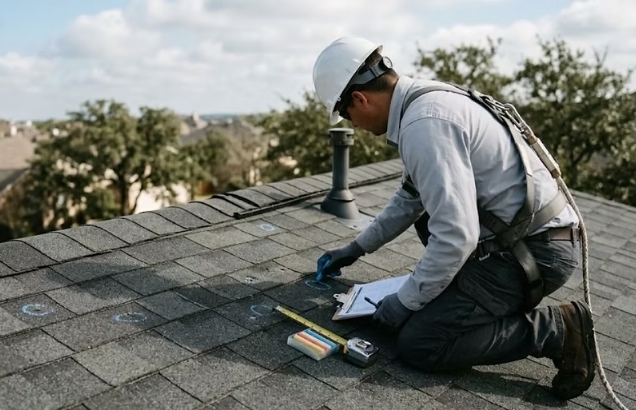
On the roof, not from the driveway, with marked and counted test squares on each slope and the attic checked from underneath.
Dated photographs, wide and close, soft metal evidence from gutters and screens, and a written scope covering every component the storm touched.
Protection where the roof is open, documented separately for the claim.
We attend the adjuster’s inspection and read the returned scope with you, line by line, against our own documentation.
Roof, gutters, siding, windows, fencing and outdoor structures, with the permit position established for each element before the work is scoped.
If a storm has recently crossed Lowry Crossing, the signs worth acting on are:
Our Lowry Crossing storm damage repair covers the visible damage and the damage that will not announce itself for a season.
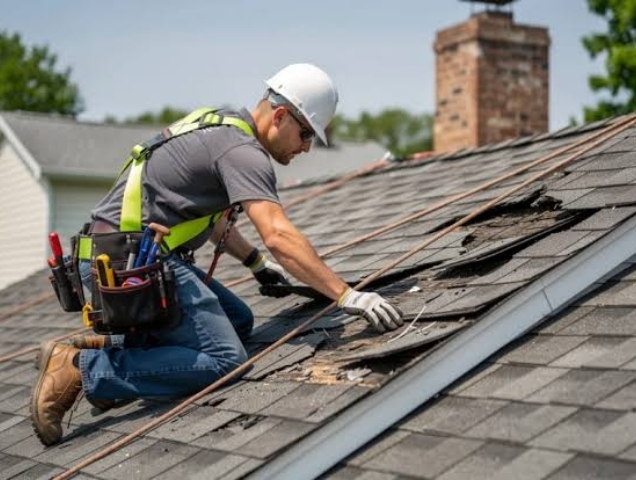
Signs replacement is the right call:
Tear off to the deck, every sheet inspected with damaged sheets replaced at an agreed per sheet rate, synthetic underlayment, ice and water shield in valleys and at penetrations, new drip edge and flashing rather than reused, new pipe boots, and balanced intake and exhaust ventilation. Most homes here are a single day of tear off and install, with a second day on larger or steeper roofs, plus the permit process described below.
Get a free estimate and we will put the recommendation in writing either way.


We sort the permit position out for every element, not just the roof, because this city permits windows, fences and patio covers individually.

We prepare and deliver the paper application, because there is no online portal here and an incomplete submission does not get resolved with a click.

The decking rate is agreed before tear off.

Tree and limb work goes in the scope where it is part of the problem, rather than being left for you to arrange.

You get the photographs either way, whether or not you hire us.

We do not knock doors after storms.
We serve every residential and commercial area across Lowry Crossing and the surrounding parts of central Collin County, including:

Bridgefarmer Road
US 380 Corridor
Acreage Lots
Milligan WSC Area
Toward McKinney
Toward Princeton
Do not see your neighborhood listed? Call (469) 598-0899 and we will confirm service for your address.
Our Lowry Crossing service area covers homes and businesses near:
Milligan Water Supply, established around 1964, serves roughly 1,965 households in and around the city, and the volunteer fire department formed in January 1984 is dispatched by the Collin County Sheriff’s Office.
This is the most useful thing on this page.
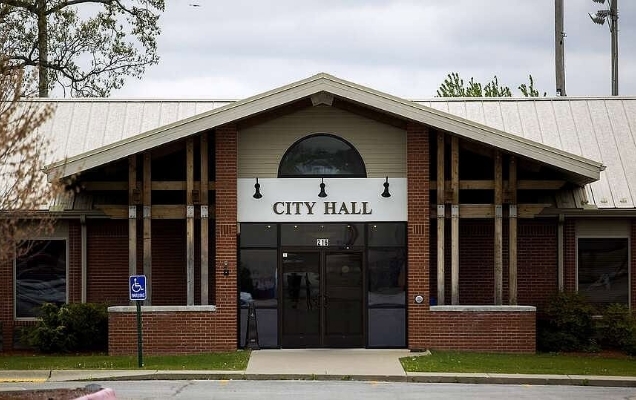
The City of Lowry Crossing publishes a list of projects that require a permit, and it is longer than the list in most cities this size. It includes accessory buildings, additions, awnings, carports, culverts, decks, driveways, electrical work, fences, foundation repair, HVAC, water heaters, windows, lawn irrigation, patio covers, plumbing, pools and sidewalks. The city ends the list with “and more”, and adds that if you have questions about whether you need a permit, contact City Hall.
Read that list again with a storm in mind. Windows. Fences. Patio covers. Foundation repair. Four of the things a hailstorm most commonly damages are named individually as permitted work in this city.
Roofing is not named explicitly on the published list, which is exactly why the city’s own advice applies: ask before you start. We do that as a matter of course, for every element of the job rather than just the roof.
The process here is paper. The city publishes a Building Permit Form, required for all building permit applications, which is downloaded, completed and returned to City Hall with all supporting documentation, with a separate form for commercial construction. There is no online portal. That is not a problem, it is a different rhythm: the application has to be right the first time, the documentation has to go with it, and somebody has to physically get it to City Hall. That is our job, and we build the days into the schedule rather than discovering them at the end.
The city also notes that pools require a permit issued by Collin County Development Services before the city can issue its own, which tells you something useful about how this city works with the county.
Roofing is not named individually on the city’s published permit list, but that list is long, it ends with “and more”, and the city’s own guidance is to contact City Hall if you have questions about whether a permit is needed. We ask on your behalf, for every element of the job, before anything is scheduled.
Both are named individually on the city’s permit list, along with patio covers, foundation repair, decks, carports, awnings, driveways and culverts. If a storm damaged your windows and your fence as well as your roof, that is potentially more than one application, and it is a reason to have a single contractor handle the whole job rather than three.
The city publishes a Building Permit Form required for all applications. It is downloaded, completed and returned to City Hall with supporting documentation, with a separate form for commercial construction. There is no online portal, so the application has to be right the first time. We prepare and deliver it.
Usually you cannot tell from the ground. Look at the soft metal first: dents on gutters, downspouts, vents or window screens mean the roof took the same impacts. Confirming it needs someone on the roof marking test squares.
Yes, in two ways. Less shelter from neighboring structures means more wind exposure, and mature trees near a roof mean limb impact damage, more debris in valleys and gutters, and overhanging branches that abrade shingles over time. We include tree and limb work in the scope where it is part of the problem.
It depends on the size and pitch of the roof, the material, how many layers come off and how much decking is damaged. We will not quote a figure without seeing it. What we will give you is a written specification with a per sheet decking rate agreed in advance.
Most homes here are a single day of tear off and install, with a second day on larger or more complex roofs, plus the permit process. Weather moves it, and after a widespread hail event material lead times move it more than labor does.
Sometimes. Color lines get discontinued and existing shingle weathers, so an exact match on an older roof is not always available. We tell you before the work whether a repair will be visible from the street.
That depends on your carrier and your claims history, and no roofer can answer it for your policy. Your agent can, and it is worth asking before you file rather than after.
Yes, and they should be inspected and photographed after a storm. Detached structures commonly sit under a different part of a homeowner’s policy with their own limit, shown on your declarations page. It will not be covered at all if nobody documented it.
If a storm has been through, or there is a stain on a ceiling and no obvious source, the inspection is the whole first step and it costs nothing.
Call (469) 598-0899 or request your free inspection.
© Copyrighted 2026 All Around Texas Roofing. All Rights Reserved. Powered by Fast Hippo Media.
 info@allaroundtexasroofing.com
  Schedule Now
 (469) 598-0899