 info@allaroundtexasroofing.com
 Schedule Now
 (469) 598-0899
After a windstorm crosses Collin County, one street can look untouched while the next has shingles scattered across the lawns. Some of that is the storm itself, which never hits two blocks the same way. A lot of it comes down to three things decided long before the storm: which shingle went on the roof, what wind rating it carried, and whether it was nailed and sealed the way the rating assumes.
TL;DR
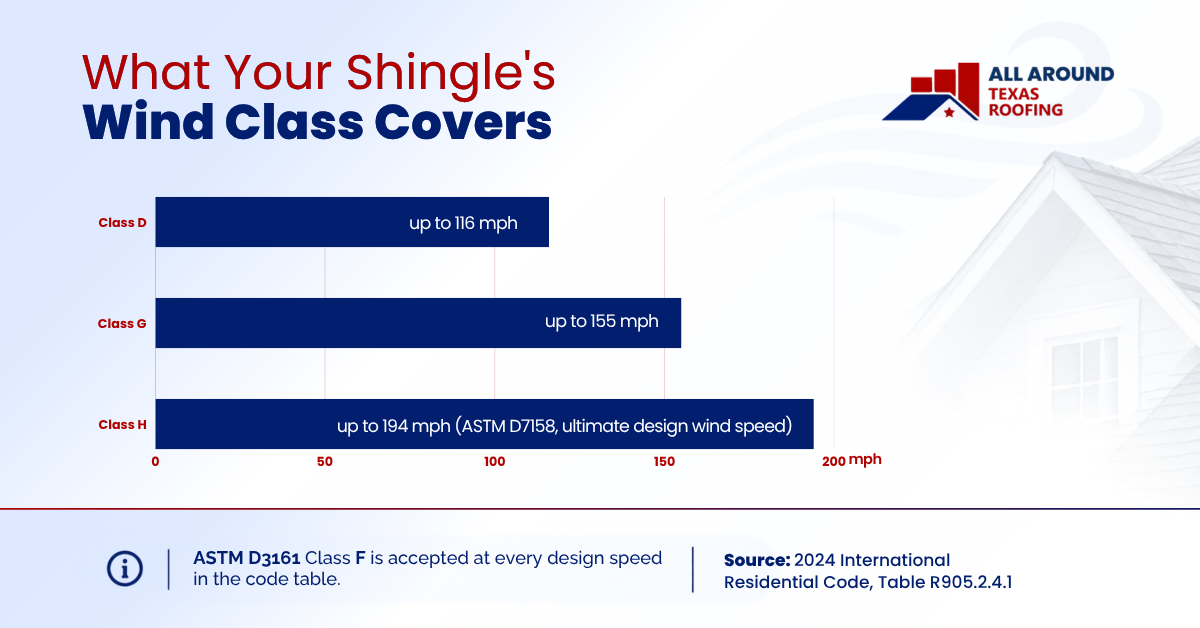
A shingle wind rating is a laboratory classification printed on the bundle that tells you what wind speed the shingle was tested to resist. Two standards are used. ASTM D7158 gives classes D, G, and H, and ASTM D3161 gives classes A, D, and F. The 2024 International Residential Code, Table R905.2.4.1, maps those classes to design wind speeds: Class D shingles to an ultimate design wind speed of 116 mph, Class G to 155 mph, and Class H to 194 mph, with D3161 Class F accepted across the whole table.
A rating assumes the shingles were installed to the manufacturer’s instructions and have sealed down, which is why nailing and sealing matter as much as the class. Manufacturer wind warranties are separate again, and they typically replace shingles rather than paying labor. For a Collin County roof, the rating, the nailing, and the sealing together decide how a roof handles the next storm.
Why Wind Takes Shingles Off One Roof and Not the Next
Wind does not push shingles off a roof so much as lift them. Air flowing over the roof creates suction, strongest at the edges, corners, and ridge, and that suction pulls up on the lower edge of each shingle.
A shingle resists that pull in three ways: the nails through it, the strip of sealant bonding it to the shingle below, and its own stiffness. When any of those is weak, the edge lifts, the wind gets underneath, and the shingle tears free or folds back.
So when two neighboring roofs fare differently in the same storm, the usual reasons are:
| Reason | What it looks like |
|---|---|
| Different shingle product and rating | One roof carries a higher wind class |
| Nailing | Too few nails, or nails placed too high above the nailing line |
| Sealing | Shingles that never fully bonded, often from a cool-season install |
| Age | Sealant and asphalt that have hardened and let go |
| Exposure | Edges and corners facing open ground or the prevailing storm direction |
What Do the Wind Classes on a Shingle Bundle Mean?
The wind classes on a shingle bundle tell you which laboratory test the shingle passed and at what wind level. The residential code requires shingles to be tested to ASTM D7158 and labeled with the class, or, for shingles outside that test’s scope, tested to ASTM D3161 and labeled with that class instead.
The two tests work differently. D7158 measures how strongly a sealed shingle resists being pulled up and calculates whether that resistance beats the uplift force at a given wind speed. D3161 blows a stream of air across test panels with a fan. ASTM’s own description of D3161 notes that its results do not directly correlate to wind speeds experienced in service.
The code does the translation. Section R905.2.4.1 of the 2024 International Residential Code requires shingle packaging to carry a label showing the classification, and its Table R905.2.4.1 sets which classes are allowed at which design wind speeds.
| Maximum ultimate design wind speed | ASTM D7158 classes allowed | ASTM D3161 classes allowed |
|---|---|---|
| 110 mph | D, G or H | A, D or F |
| 116 mph | D, G or H | A, D or F |
| 129 mph | G or H | A, D, or F |
| 142 mph | G or H | F |
| 155 mph | G or H | F |
| 168 mph | H | F |
| 181 mph | H | F |
| 194 mph | H | F |
Read down the D7158 column and the classes fall into place: Class D covers design wind speeds up to 116 mph, Class G up to 155 mph, and Class H up to 194 mph. D3161 Class F is allowed at every speed in the table.
Design wind speed is not the storm you saw on the news
The speeds in the table are engineering design values from the code’s wind maps, used to size a building for the wind it should withstand. They are not a promise that a roof will survive any gust up to that number, and they are not the same as the gust a weather station records. Your city’s building department can tell you the design wind speed it uses for your address.
How Strong Does North Texas Wind Actually Get?
Strong enough to matter, most years. The National Severe Storms Laboratory’s guide to thunderstorm basics classifies a thunderstorm as severe when it produces hail one inch or larger, a tornado, or winds gusting in excess of 50 knots, which it gives as 57.5 mph. The same guide says straight-line winds from thunderstorms can reach more than 120 mph, and that the greatest severe weather threat in the United States runs from Texas to southern Minnesota.
Locally, the federal storm record shows how often that happens. Our count of the NOAA Storm Events Database for 2021 through 2025 found 60 thunderstorm wind reports in Collin County and 86 in Denton County. In 2025 alone, Collin County logged 30, as many as the previous four years combined, and Denton County logged 42.
Two cautions about those numbers. A report depends on someone seeing and reporting the storm, so they count reports, not how often wind hits a given street. And most severe wind gusts are well below the speeds in the code table. The damage in a typical North Texas windstorm usually comes from weak spots in the roof, not from wind that overpowered a well-installed, well-sealed shingle.
Nailing and Sealing Decide Whether the Rating Holds
A wind rating is earned in a lab on shingles installed to the manufacturer’s instructions and allowed to seal. On a real roof, the rating only holds if the install matches those conditions.
ASTM’s D7158 standard spells out the point in its own scope. It states that many factors influence how shingles seal in the field, naming temperature, time, roof slope, dirt and debris, and fasteners that are misaligned or underdriven and interfere with sealing, and that its classification is based on shingles sealed under defined conditions before testing.
That leaves two jobs for the installer.
Nailing
Every shingle has a nailing zone marked by the manufacturer. Nails placed too high miss the shingle below and hold only one layer. Nails driven crooked or not flush interfere with the sealant strip. Too few nails leave the shingle relying on sealant alone. The manufacturer’s instructions set the count and the placement, and the code requires shingles to be installed to those instructions.
Sealing
The sealant strip needs warmth and sun to bond. Atlas Roofing’s current residential limited shingle warranty puts it plainly: to activate the sealant, the shingles must be exposed to direct sunlight for a continued period, and shingles installed in fall or winter without adequate surface temperatures may never seal and must be hand sealed at the time of installation.
In North Texas, most roofs seal quickly in the warm months. A roof put on in a cool stretch of December may not bond until spring, and a strong front in between can lift shingles that simply had not sealed yet.
What the Manufacturer’s Wind Warranty Actually Covers
A shingle’s wind warranty is a separate promise from its code rating, and it is narrower than most homeowners assume.
The Atlas warranty is a useful example of how these are written. It warrants the shingles against damage from wind gusts up to a maximum speed listed in its warranty details chart, provided the shingles were installed according to the printed instructions on the bundle wrapper and have had the opportunity to seal down. If damage occurs within the wind warranty period, it provides replacement shingles for the damaged shingles only, not replacement labor. It sets that wind coverage period at 15 years for its lifetime shingles and 5 years for its other shingles, from the date of installation.
It also lists gusts above the specified wind speed limits, along with hailstorms, tornadoes, and other violent storms, among acts of God it does not cover.
| Question | What a typical wind warranty says |
|---|---|
| What speed is covered? | Up to the limit in the manufacturer’s chart |
| What if the shingles had not sealed? | Coverage assumes they had the chance to seal |
| Does it pay labor? | Often not; replacement shingles only |
| How long does it last? | A set number of years, often shorter than the shingle’s overall warranty |
| Does it cover storms above the limit? | No; that is what homeowners insurance is for |
The practical upshot: after a windstorm, the manufacturer’s warranty is rarely where the money comes from. Homeowners insurance usually is, which is why our wind damage claim checklist for Texas is the more useful document the morning after.
Other manufacturers word their wind coverage differently. Read the warranty for the shingle on your roof.
Choosing a Wind Rating for a New Roof in Collin County
When a roof is being replaced anyway, a higher wind class costs a difference in price rather than a separate project, and it tends to come with other upgrades in the same product line.
A few points worth weighing:
- The code sets a minimum for your design wind speed. Nothing stops you from going above it.
- Higher wind classes are common on the same impact-resistant lines many homeowners already consider for hail.
- The IBHS FORTIFIED Roof standard requires shingles rated ASTM D3161 Class F or ASTM D7158 Class H, the top classes in each test.
- A higher-rated shingle installed with poor nailing performs like a lower-rated one.
In an HOA neighborhood, Texas law also helps. The Property Code limits an association’s power to ban shingles designed primarily to be wind and hail-resistant, as long as they resemble the neighborhood’s shingles.
After a Windstorm: What to Check From the Ground
You do not need to climb a roof to spot most wind damage. From the yard, after the wind has died down, look for:
- Shingles or pieces of shingle in the yard or gutters
- Bare patches, often dark rectangles where a shingle tab used to be
- Shingles lifted or creased along a straight line, a sign they folded back in the wind
- Ridge cap pieces missing or out of line along the peak
- Damage concentrated at edges, corners, and the ridge, where uplift is strongest
Creased shingles are easy to miss and worth noting.
Why the edges go first
Uplift is not spread evenly across a roof. It is strongest along the eaves, the rakes, the corners, and the ridge, where wind flowing over the house separates from the surface. That is why wind damage so often starts with a single row along one edge and works inward, and why the code and manufacturers pay special attention to starter strips and edge nailing. If the first shingles you see missing are at a corner, that is the pattern you would expect, not a sign the whole roof is failing. A shingle that folded back and fell into place again may look fine from a distance, but its seal is broken, and the crease weakens it for the next storm.
If you see any of these, photograph them with the date. Our wind damage repair page covers what happens next.
Have Your Roof’s Wind Readiness Checked Before Spring
Spring brings the busiest storm weeks to North Texas. If your roof is older, went on in a cold season, or has lost shingles before, it is worth knowing where it stands before the season starts. We work across Collin and Denton County, from Celina, Prosper, and Frisco to McKinney and Princeton.
If you are in Celina, our Celina roofing page covers the local details. Anywhere else, call (469) 598-0899, or start with All Around Texas Roofing online.