 info@allaroundtexasroofing.com
 Schedule Now
 (469) 598-0899
TL;DR
To document roof damage for an insurance claim in Texas, build a file that proves cause, date, and function. Shoot the roof in layers: wide slope shots that show orientation, medium shots that show where damage clusters, close-ups with a coin or tape measure in frame for scale. Photograph soft metal (gutters, vent caps, flashing, the AC condenser fins) because dented metal corroborates hail on shingles.
Add interior ceiling and attic photos, the storm date, and any pre-storm images you already have. Keep torn shingles and debris until the adjuster releases them. Then be on the roof, or at the ladder, when the adjuster inspects, and get a written scope from your own roofer first.
What an Adjuster Is Actually Deciding Up There
Three decisions get made during a roof inspection, and they happen in order.
First is cause of loss. Did hail or wind break this roof, or did fifteen North Texas summers do it? Policies pay for sudden events, not for age, and that single distinction decides most disputed claims before anyone talks about money.
Second is date of loss. Carriers need the damage tied to a specific storm, because the policy in force on that date sets the terms. A vague “sometime this spring” invites a carrier to ask whether the damage predates your coverage.
Third is function. Is water getting in, or will it? A shingle with a fractured mat has lost the thing it was made to do, even when it looks flat and normal from the driveway. Some Texas policies now carve out damage that is only cosmetic, which is why the distinction has teeth.
Here is the part homeowners rarely hear said plainly. An adjuster is not obligated to hunt for damage you have not shown them. They evaluate the roof in front of them during the time they have on it, write what they observed, and move to the next inspection.
During a busy week after a Collin County hail event, that inspection can run twenty minutes. Your documentation is what stretches those twenty minutes into a complete scope.
Texas requires insurance adjusters to hold a license, and the Texas Department of Insurance runs a public agent and adjuster lookup where you can check the person standing in your driveway by name or license number. Nobody does this. It takes two minutes.
The Photo Set That Survives a Second Reader
Assume the adjuster who visits your house is not the person who decides your claim. Someone at a desk, weeks later, will page through the file. Every photo has to make sense to that second reader with no verbal explanation attached.
That is the standard we shoot for, and it changes how the set is built.
Start wide, and show which way the slope faces
Begin from the ground on all four sides of the house. Get the whole elevation in frame, including a recognizable landmark such as the street or the fence line. Wide shots establish which slope is which, and slope orientation is what ties your damage to the direction the storm came from.
Photograph the yard too. Torn shingle pieces on the lawn, granules washed into the flower beds, a bent gutter downspout, shredded leaves stripped off the crepe myrtles. That debris field is corroborating evidence, and it disappears the first time somebody mows.
Move in close, with something in frame for scale
Close-ups without a reference object are the most common weakness in a homeowner file. A dark circle on a shingle could be two inches across or half an inch, and the reader cannot tell. Put a quarter or a tape measure next to the mark in at least a third of your close shots.
Shoot lifted or creased shingles from the side rather than from above, so the raised edge and the broken sealant strip both read. Angle the light across the surface. Damage that vanishes in flat midday sun shows up clearly at eight in the morning.
Do not skip the soft metal
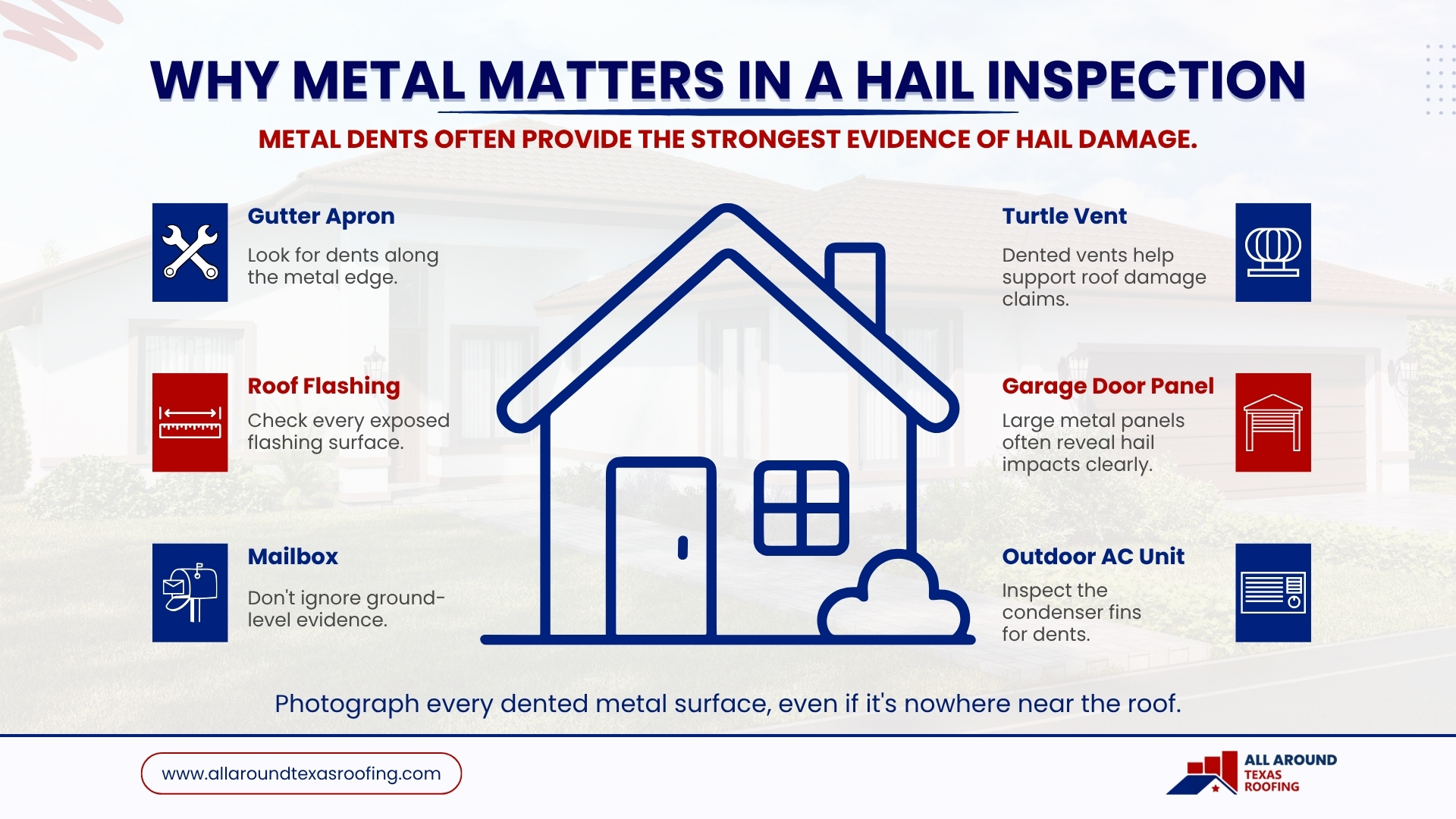
Shingles are subjective. Metal is not. Hail dents gutter aprons and vent caps, turtle vents, roof-mounted flashing, garage door panels, mailboxes, even the fins on your outdoor AC unit. Adjusters lean on those dents because metal deforms at a predictable rate, so a dented vent cap supports the shingle bruises you are claiming.
Photograph every dented metal surface on the property, including the ones nowhere near the roof.
Go inside, then go up in the attic
Water stains on a ceiling, a bubbled patch of drywall, a damp rafter, daylight visible through decking. Interior photos prove the functional damage argument better than anything on the exterior does, and plenty of homeowners never take a single one.
Date everything. Phone photos carry timestamps in their metadata by default, so send the original files rather than screenshots or images pasted into a document, which strip that data out.
| Shot type | How many | What it proves |
| Wide elevation, all four sides | 4 to 8 | Slope orientation and storm direction |
| Medium, per damaged slope | 3 to 5 each | Where damage clusters, and how densely |
| Close-up with scale reference | 15 to 30 | Size and character of individual impacts |
| Soft metal and accessories | 5 to 15 | Independent corroboration of hail energy |
| Interior and attic | 5 to 10 | Functional damage, water intrusion |
| Yard debris | 3 to 6 | Material came off the roof during the event |
One more thing, straight from the state. The Texas Department of Insurance tells homeowners not to throw anything away until the adjuster says so. Torn shingles, a broken vent cap, the section of fascia that came down: bag it, label the bag with the date, and set it in the garage.
How Does an Adjuster Measure Hail Damage?
Most adjusters mark out a test square on each slope, typically ten feet by ten feet, then count qualifying impacts inside that square and treat the result as representative of the whole slope. Chalk circles appear around each hit so the marks photograph clearly. Carriers set their own thresholds for how many hits per square justify replacing a slope, and those thresholds are internal, not public.
This method is industry convention rather than law, so we describe it as what we see on roofs, not as a rule anybody has to follow.
Knowing it exists changes what you do. If your damage is concentrated on one section of a slope and the adjuster squares off a clean area twenty feet away, the count comes back low, and the slope reads as undamaged. You are allowed to point at the cluster and ask that a square be marked there as well. Doing that politely, while standing at the ladder, costs nothing.
Watch the chalk after they climb down. Marked slopes usually mean a scope is coming. An unmarked roof usually means the adjuster found nothing they intend to write, and that is the moment to say so out loud rather than three weeks later.
Your County’s Storm Record Is Public, and It Is Evidence
NOAA’s National Centers for Environmental Information runs the Storm Events Database, a free public archive of severe weather reports going back to January 1950. You can filter by state, county, event type, and date. Nobody charges you, and no login is required.
For Collin County, the record is dense. During 2025, the database logged 33 hail reports and 30 thunderstorm wind reports in the county. The March 25 outbreak dropped stones up to 2.25 inches at Parker and 1.25 inches at McKinney. Gusts measured 75 mph on March 4 that same year at McKinney, 75 mph at Allen, and 69 mph at Prosper.
What surprises people is how late the season runs. September 5, 2025 brought two separate 70-plus mph wind reports at Celina and another at Anna. Sixteen days later, on September 21, hail reached 2.00 inches at Melissa and 1.75 inches at Anna. Anyone who assumes storm season ends when school starts is working from the wrong calendar, and roofs that took a hit in September get inspected in October with the damage already a month old.
The 2026 record is thinner so far. Database coverage currently runs through April 2026, and within that window Collin County shows three hail reports, all on April 27, at Murphy and Wylie, ranging from 1.00 to 1.25 inches. Later events have not been published yet, which is worth understanding before you conclude your storm was never recorded.
Pull the report for your date and county, save it as a PDF, and put it in the claim file next to your photos. A dated public weather record turns “we had a bad storm” into a documented event with a magnitude attached.
What Your Roofer Can and Cannot Do While the Adjuster Is There
Texas draws a hard line here, and a surprising number of contractors cross it.
Under Insurance Code Section 4102.163, a contractor who provides or may provide roofing services on your home is prohibited from acting as a public insurance adjuster for that claim. In plain terms: a roofer cannot negotiate your settlement, cannot promise to recover a specific dollar amount, and cannot represent you to your carrier. The Texas Department of Insurance spells this out on its roofing and insurance page, last updated in March 2025.
What a roofer can legitimately do is inspect the roof, measure it, then produce a written scope of the damage, then be present while the adjuster works so the technical conversation happens between two people who climb roofs for a living. That is the difference between advocacy and adjusting, and it matters because a contractor who offers to “handle your claim” is telling you they either do not know the law or do not care.
Two more rules sit on that same TDI page. A deductible has to be paid by the policyholder, and it is illegal for a contractor to waive, rebate, absorb, or offset it. Any contract of $1,000 or more that involves an insurance settlement must carry written notice that you are responsible for that deductible. Keep the canceled check or receipt, because your carrier may ask for proof.
And there is the knock at the door. The Texas Attorney General’s disaster scams guidance covers this directly: when a contract is signed at your home, it must include a notice of cancellation giving you three business days to change your mind. The same guidance says to get more than one estimate, never sign a contract with blanks in it, and check the contractor out before signing. Storm chasers move through McKinney and Prosper subdivisions within hours of a hail event, and the three-day window is your protection when someone talks fast on a Saturday afternoon.
When your own inspection shows the roof is compromised, we scope the storm damage roof repair in North Texas in writing first, so the number in front of the adjuster comes from a measurement rather than a conversation. If the damage runs deep enough that patching a slope makes no sense, a written full roof replacement scope belongs in the file too.
Reading the Estimate After the Adjuster Leaves
You will receive a line-item estimate, usually built in claims-estimating software, listing every component with a quantity, a unit price, and a depreciation figure. It is dense, and it is negotiable on the facts.
Read it for omissions before you read it for dollars. Common gaps we see on North Texas scopes: ridge cap counted as field shingle, drip edge left out entirely, no allowance for ice and water shield in the valleys, pipe boots and vent caps missing, decking replacement priced at zero when the deck is already known to be soft, and steep or two-story access not accounted for. Each omission is a factual question with a factual answer, which is a much better argument than saying the total feels low.
Now look at the two totals.
| Figure on the estimate | What it means | Does the rest come back? |
| Replacement cost value | Full cost of the work at today’s prices | Yes, on an RCV policy, once the work is finished and invoiced |
| Actual cash value | RCV minus depreciation for age and wear, and usually what the first check pays | No, on an ACV policy |
So a low first check is not always a low settlement. On an actual cash value policy, though, the withheld amount never comes back, and an older roof can settle well below what the repair costs.
If the scope missed something, the Texas Department of Insurance says to tell the company why you disagree and send supporting documentation, such as a contractor’s estimate. That is how a supplement starts. Send the specific line and the photo that contradicts it.
What If the Adjuster Says There Is No Hail Damage?
Ask for the denial in writing with the reasoning stated, then request a reinspection with your roofer present. Carriers grant reinspections routinely, and a second adjuster on the same roof with someone pointing at chalk-free clusters produces a different result often enough to be worth the phone call.
Most Texas homeowner policies also include an appraisal provision. The Texas Department of Insurance describes how it works: you and the company each hire an appraiser, the two appraisers pick a third as umpire, and the umpire’s decision on the amount of damage binds both sides. You pay for your own appraiser and half of the umpire’s costs, so it suits a real dispute over scope rather than a disagreement about a few hundred dollars.
TDI also takes complaints about unfair treatment through its online complaint system and its help line at 800-252-3439. Contractor fraud, including a roofer who took the insurance proceeds and vanished, goes to the Attorney General’s Consumer Protection Division at 800-621-0508.
Getting Your Roof Documented Before the Adjuster Arrives
The homeowners who do well on storm claims are the ones whose file was already complete when the adjuster pulled into the driveway. Dated layered photos, a public weather record for the date of loss, interior shots, the debris still bagged in the garage, and a written scope from a roofer who measured the whole roof rather than glancing at one slope.
None of that requires special access or a special relationship with anybody. It requires doing the work before the twenty-minute inspection instead of after it.
If a storm has come through Collin County and you want the damage documented properly first, All Around Texas Roofing inspects roofs across McKinney, Celina, and the surrounding North Texas towns.