
All Around Texas Roofing repairs pergolas, patio covers and outdoor structures across Frisco, McKinney, Prosper, Celina, Anna, Melissa, Aubrey and the surrounding Collin and Denton County communities. Wind lifted covers, shifted posts, cracked panels, storm damaged beams, and the leak where an attached cover meets the house.
That last one is why this work sits with a roofing contractor rather than a handyman, and it is the section below worth reading first.
Call (469) 598-0899 to schedule a free inspection of the structure and the junction.
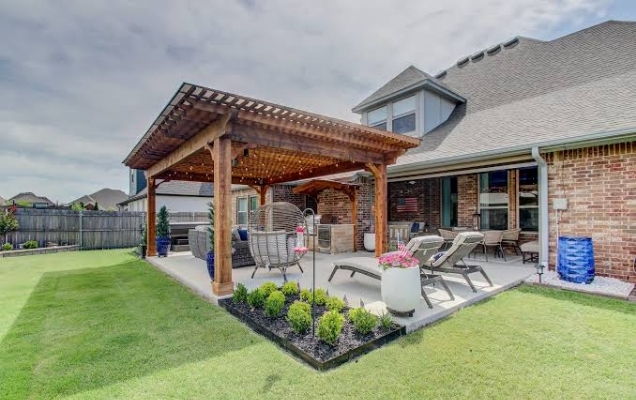
Pergolas and patio covers are among the most frequently omitted items on a North Texas storm claim, and the reason is mundane: the inspection was about the roof, and nobody walked round the back.
They are also among the easiest things to document once somebody does. Lifted fixings, displaced panels, dented metal and shifted posts are all unambiguous in a photograph.
So a storm inspection here covers every outdoor structure, and it goes in the scope with the roof, the fence, the gutters and the screens. Damage from one storm event belongs on one claim against one deductible.
Whether your policy covers a given structure, and under which part, is between you, your declarations page and your agent. Our job is making sure it is documented rather than overlooked, because an undocumented structure is definitely not going to be paid for. See insurance claim assistance.

at shoulder height, because most serious failures are foundation failures wearing a costume.
on an attached cover, before anything else.
which back out over time under thermal movement and are what wind takes first.
so you know before quoting whether a match exists.
for your address.
including wall repair where water has already got in.
Wind uplift is the main one. A patio cover is a large horizontal surface with open air underneath it, which makes it behave like a wing. Wind gets under it and lifts, and the load goes straight into the fixings. A cover can be structurally compromised while still standing and looking fine from the kitchen window.
Hail dents and cracks the cover. Metal panels dent, and a dented panel that no longer drains will hold water. Polycarbonate cracks and becomes progressively more brittle with UV exposure, so a ten year old panel fails at an impact a new one would have shrugged off. Yellowing is the visible sign the material has aged.
Falling limbs break beams and rafters, usually taking several panels with them.
Saturated ground shifts posts. Much of Collin and Denton County sits on expansive clay that swells when wet and shrinks when dry, and every cycle works a footing slightly looser. That is why a structure standing for eight years can fail in a storm no worse than several it survived.
The important point: a structure that survived a storm is not necessarily undamaged. Connections loosen and fixings pull partway out, and those are the failures that show up during the next storm.
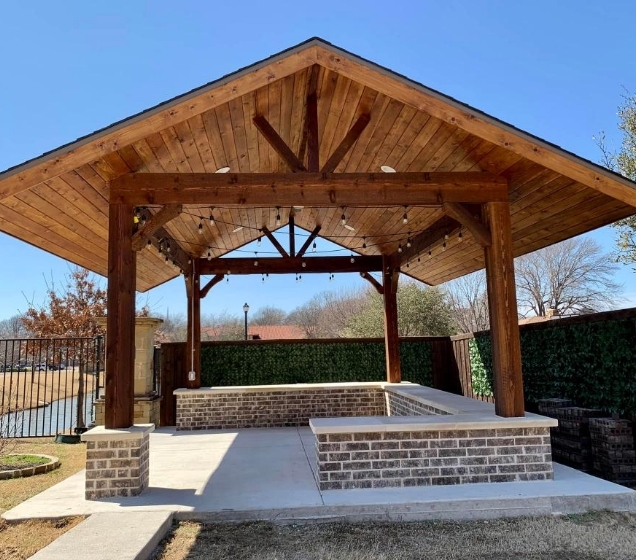

Patio covers are frequently permitted work, and the answer genuinely differs across this service area.
The City of Aubrey lists a patio cover permit application, grouped with accessory buildings and fences. The City of Lowry Crossing names patio covers, carports, decks and awnings individually on its list of projects requiring a permit. Other cities treat a like for like repair differently from a rebuild.
Separately, most master planned neighborhoods here have an architectural committee with rules covering height, material, roof pitch, color and whether anything may be attached to the house at all.
We confirm the city requirement for your address and handle the HOA submission where one is needed. Rebuilding a structure twice because the committee said no the first time is an avoidable expense.

We treat the ledger as a roofing detail, because it is one, and it is where the leaks are.

We push the posts before quoting, so a repair is not built on a failing footing.

We open the wall behind the ledger where water has been getting in, rather than covering it.

We identify the panel profile first, since polycarbonate yellows and matching gets harder with age.

Permit and HOA submission handled, not handed back to you.

One contractor for the roof and the cover, so nobody argues about whose junction it is.
We repair pergolas and patio covers across:
Our office is on Preston Road in Frisco.
If the storm that damaged your cover also hit the house, start with a free roof inspection and see storm damage repair for the rest of the property.
 4.9★ Rating from 1,235+ Texas Roofing Customers

It depends on the policy and on whether the structure is attached or freestanding. Attached covers commonly sit under the dwelling part, freestanding structures commonly under the other structures part with its own limit shown as a percentage on your declarations page. Whether yours is covered is a question for your agent. What we make sure of is that the damage is documented as part of the same storm claim as the roof.
Almost always because the ledger flashing has failed, was never installed correctly, or has at some point been replaced with sealant. That junction is a roof to wall detail and it has to shed water over the joint rather than rely on a bead of something. Water getting in there does not stay there, which is why a ledger leak often shows up as a ceiling stain in the room behind the patio.
Yes. Wind uplift loosens connections and shifts posts without necessarily displacing anything visibly, and a structure weakened in one storm is the one that leaves the property in the next.
Often yes, if the profile is still available and the structure underneath is sound. Two complications: polycarbonate yellows with age so a new panel will not match an old run, and the fixings on the remaining panels are the same age as the ones that failed.
Usually the footing rather than the post. Much of this area sits on expansive clay that swells when wet and shrinks when dry, and each cycle works a footing looser. A post reset in new concrete at the right depth is a different proposition from a post pushed back upright.
In several cities across this service area, yes. Aubrey lists a patio cover permit application and Lowry Crossing names patio covers individually on its permit list, alongside carports, decks and awnings. Requirements differ elsewhere, and a like for like repair is often treated differently from a rebuild.
In most master planned neighborhoods here, yes, for anything beyond a like for like repair. Committees typically specify height, material, roof pitch, color and attachment. We handle the submission, and it is worth doing before material is ordered.
Yes, and on an attached cover it is the better order. The ledger junction is a roofing detail, so doing the roof and the cover as one job means one contractor owns that junction rather than two each assuming the other handled it.
Yes. A shingled cover is a small roof and we treat it as one, including the flashing where it meets the house and matching the shingle to the main roof where that is still possible.
If a storm has been through, the cover deserves the same look as the roof, and the junction where it meets the house deserves more attention than either.
Call (469) 598-0899 or request a free estimate.
© Copyrighted 2026 All Around Texas Roofing. All Rights Reserved. Powered by Fast Hippo Media.
 info@allaroundtexasroofing.com
  Schedule Now
 (469) 598-0899