 info@allaroundtexasroofing.com


 Schedule Now
 469-598-0899
When a hailstorm rolls through North Texas, most homeowners instinctively look up at the roof afterward. That makes sense, roofs take the brunt of the impact. But here’s the thing many people miss: hail rarely damages just one part of your home.
Walk around your property after a storm, and you’ll often notice dents in gutters, cracks in siding, chipped paint on trim, or even broken window seals. Fences get hit hard, too, especially wood panels facing the storm. All of this adds up.
The good news? In many cases, your insurance policy does cover these types of damage. The not-so-great news is that a lot of homeowners leave money on the table simply because they don’t understand how coverage works across different parts of the property.
Whether you need a storm damage repair, residential roofing service, or a free roof inspection in Dallas-Fort Worth and surrounding North Texas cities, knowing what to look for can save time, money, and headaches. Let’s break it down in a way that actually makes sense.
It’s Not Just the Roof: Hail Affects Your Whole Exterior
Hail doesn’t discriminate. It hits whatever is in its path, and that includes every exposed surface around your home.
After a typical Texas hailstorm, damage can show up on:
- Siding panels (vinyl, fiber cement, or wood)
- Window frames and glass
- Gutters and downspouts
- Exterior trim and fascia
- Fences and gates
- Pergolas or patio covers
- Skylights and vents
Some of this damage is obvious, like cracked glass. Other times, it’s subtle. Small dents or impact marks might not seem like a big deal at first, but they can lead to bigger problems over time, especially with water intrusion.
That’s why it’s important to look beyond the roof when thinking about an insurance claim.
How Insurance Coverage Is Structured
Most Texas homeowner’s insurance policies divide coverage into different sections. Understanding this is where things start to click.
Dwelling Coverage (Coverage A)
This is the main portion of your policy. It covers the primary structure of your home and anything attached to it.
That includes:
- Roof
- Siding
- Windows
- Gutters
- Soffit and fascia
- Exterior trim
If hail damages any of these, repairs or replacement are typically covered, as long as the storm qualifies as a covered event.
Here’s where it gets interesting. Let’s say hail damages your siding, but only on one side of the house. If the material is discontinued and can’t be matched, many policies will allow for the replacement of the entire affected elevation, so everything looks consistent.
That’s not something most homeowners think to ask about.
Other Structures Coverage (Coverage B)
Now let’s step away from the house itself.
Anything on your property that isn’t attached to your home usually falls under “other structures” coverage.
This often includes:
- Fences
- Detached garages
- Pergolas
- Sheds
Coverage B is usually set at around 10% of your dwelling coverage.
So if your home is insured for $400,000, you may have about $40,000 available for these structures. That’s more than enough to handle major fence repairs or replacement after a strong hailstorm.
The Strategy Most Homeowners Miss: Bundling Everything Into One Claim
Here’s where things can really work in your favor if handled correctly.
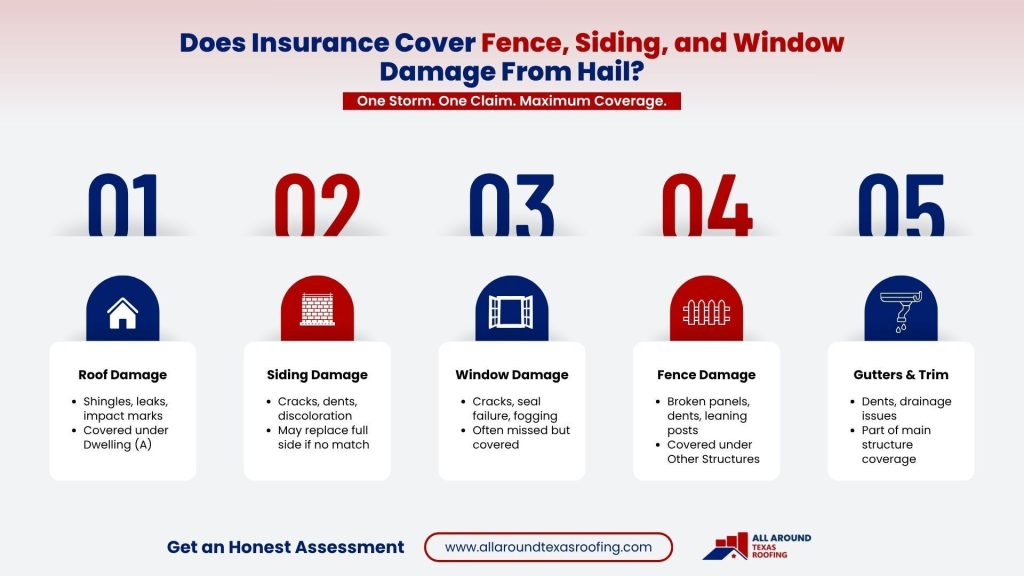
When a single storm damages multiple parts of your property, you don’t need separate claims for each item. Everything can go into one claim.
That means:
- Roof damage
- Siding damage
- Window damage
- Fence damage
- Gutters and trim
All documented together.
Why does this matter?
Because you only pay one deductible.
So instead of filing separate claims and paying out of pocket multiple times, you group everything into a single, larger claim. This often leads to a higher total payout while keeping your cost the same.
It’s not a loophole. It’s simply how the system is set up.
Why Documentation Makes or Breaks Your Claim
Insurance companies rely heavily on what they can see and verify. If something isn’t documented clearly, it’s easy for it to be missed or left out of the estimate.
That’s why thorough documentation is so important.
A strong claim usually includes:
- Clear, close-up photos of damage
- Wide shots showing location and context
- Measurements and material details
- Notes that match insurance estimating standards
This is where having someone experienced on your side can make a big difference. Not because the damage isn’t real, but because it needs to be presented in a way adjusters understand.
A small dent in a gutter might not look like much to a homeowner. To an adjuster, it can justify the replacement of an entire section when documented properly.
The Adjuster Visit: What Really Happens
Once you file a claim, the insurance company sends out an adjuster to inspect the damage.
Here’s the truth: many adjusters focus heavily on the roof.
It’s the largest and most obvious area of concern, so that’s where most of their time goes. As a result, things like siding, windows, or fence damage may not get the same level of attention.
That doesn’t mean they won’t cover it. It just means it might not be fully captured during the first inspection.
Having your contractor present during this visit helps ensure nothing gets overlooked. If something is missed, it can still be added later through a supplemental request, but it’s always smoother to catch it upfront.
What About Windows? They’re Often Overlooked
Window damage from hail can show up in a few different ways:
- Cracked or shattered glass
- Broken seals are causing fogging between panes
- Damaged frames or trim
Even if the glass isn’t completely broken, seal failure can reduce energy efficiency and lead to long-term issues.
Most policies cover window damage under dwelling coverage, including both the glass and the frame when needed.
Still, this is one of the most commonly missed items during inspections. It’s easy to overlook unless someone is specifically checking for it.
Fence Damage: More Than Just Cosmetic
Fences take direct hits during hailstorms, especially when combined with strong winds.
Common issues include:
- Splintered wood panels
- Dents in metal fencing
- Leaning or broken posts
- Paint or stain damage
Because fences fall under “other structures,” they’re covered differently than the main house, but they’re still part of the claim.
A damaged fence might not feel urgent compared to a leaking roof, but leaving it unrepaired can lead to further structural problems over time.
Siding Damage: The Matching Problem
Siding claims can get tricky, especially when materials are older or no longer available.
Hail damage might leave visible dents, cracks, or chipped finishes. But even if only part of the siding is damaged, replacing just that section can create a mismatch.
Many policies address this by allowing replacement of the full affected area when matching isn’t possible.
That’s something worth documenting carefully. Photos, product details, and the age of materials all play a role in how the claim is handled.
What This Looks Like in Real-World
Imagine a hailstorm hits your neighborhood.
Afterward, you notice:
- A few missing shingles
- Dents in your gutters
- Chipped siding on one side of the house
- Fence panels with visible impact marks
If you only file for the roof, you might get a partial payout that covers shingles and some related work.
But if everything is documented and included, the claim could cover repairs across multiple parts of the property, all under one deductible.
Same storm. Same damage. Completely different outcome.
Why a Full Property Inspection Matters
A quick look from the ground isn’t enough after a hailstorm. Some damage just isn’t obvious unless you’re trained to spot it.
A proper inspection should cover:
- All roof slopes
- Every side of the home
- Windows and frames
- Gutters and drainage systems
- Fence lines and outdoor structures
That kind of thorough approach helps ensure the claim reflects what actually happened, not just what’s easy to see at first glance.
This is exactly how All Around Texas Roofing and Restoration approaches storm inspections across North Texas, making sure nothing gets overlooked before the claim process even begins.
Don’t Leave Part of Your Claim Behind
Hail damage is rarely limited to one area, and your insurance policy is designed with that in mind. The key is knowing what to look for and making sure every damaged component is included from the start.
When everything is documented properly and handled as one claim, homeowners often end up in a much better position. One deductible, broader coverage, and a clearer path to getting your property back to its original condition.
If you’re unsure whether your fence, siding, or windows were affected after a recent storm, it’s worth taking a closer look. A detailed inspection can make all the difference, and teams like All Around Texas Roofing and Restoration help homeowners across North Texas handle that process with confidence.