 info@allaroundtexasroofing.com
 Schedule Now
 (469) 598-0899
If you’re asking how much a new roof costs in Dallas, you’re not alone. It’s one of the first questions homeowners ask when shingles start curling, hail hits hard, or a home inspection flags trouble overhead.
The honest answer? Most roof replacements in Celina, TX fall between $8,000 and $25,000, with many homeowners landing in the $12,000 to $18,000 range for a standard single-family home using architectural asphalt shingles.
That’s a wide range, and for good reason. Every roof is different. Size, material, slope, storm history, labor demand, and even driveway access can change the final number. In this 2026 guide, we’ll walk through what really drives roof replacement costs in North Texas so you can understand your estimate before you sign anything.
Why Roof Prices in DFW Vary So Much
Two houses on the same street can receive very different quotes. One might be $11,500. The other could be $19,000. It doesn’t mean someone is getting overcharged. It usually comes down to math and materials.
Here’s what affects your roof replacement cost in Texas the most:
- Roof size measured in squares
- Shingle or roofing material type
- Roof pitch and architectural design
- Tear-off requirements
- Labor demand in the DFW market
- Insurance coverage type
- Ventilation upgrades
- Code compliance updates
Let’s break those down one at a time.
Roof Size: The Starting Point for Every Estimate
Roofers measure roofs in “squares.” One square equals 100 square feet of roofing area.
The average Dallas–Fort Worth home has a roof between 20 and 35 squares. That means roughly 2,000 to 3,500 square feet of roofing surface.
If your home is 30 squares and you choose shingles that cost $450 per square installed, you’re looking at about $13,500 just for that material and labor calculation. Add accessories, flashing, underlayment, ridge caps, and disposal, and the number grows.
Larger homes with steep slopes and multiple angles may require extra material because shingles overlap more on steeper roofs. That adds to the total.
Roofing Material: Asphalt, Class 4, Metal, or Tile?
Material choice is the second biggest driver of cost. North Texas homeowners have a few common options.
Architectural Asphalt Shingles
These are the most popular roofs in DFW neighborhoods like Frisco, McKinney, Prosper, and Celina, where roofing in Celina, TX, continues to grow with new residential developments.
The installed cost typically ranges from $350 to $550 per square in 2026.
They offer solid durability, good curb appeal, and reasonable pricing. For many homeowners, this hits the sweet spot between cost and performance.
Class 4 Impact-Resistant Shingles
If you’ve lived through a Texas hailstorm, you know why these matter.
Class 4 shingles are tested to resist impact from hail. They cost about $450 to $700 per square installed, depending on brand and style.
Many insurance carriers in North Texas offer premium discounts for Class 4 roofs. Some homeowners report savings up to 20 to 28 percent, depending on their policy. Over several years, that can offset the higher upfront cost.
In a region that sees multiple hail events each year, this option makes sense for many households.
Metal Roofing
Metal roofs are gaining popularity in parts of DFW.
Installed cost usually ranges from $700 to $1,200 per square, depending on panel type and gauge thickness.
They last longer than asphalt and resist wind well, though hail can still dent some styles. The higher upfront cost is the main reason many homeowners stick with shingles.
Tile Roofing
Concrete or clay tile roofs are common in upscale neighborhoods and custom homes.
Installed cost typically starts around $1,000 per square and can go higher depending on weight, structure support, and style.
Tile lasts decades but requires a structure built to carry the weight. Not every home can handle it without reinforcement.
Roof Complexity: The Hidden Cost Factor
This is where many homeowners get surprised.
A simple ranch-style roof with few angles is straightforward to replace. A home with multiple peaks, dormers, skylights, chimneys, and valleys takes much more labor.
More cuts mean more waste. More flashing means more detail work. Steep slopes require safety equipment and slow down installation.
All of that adds labor time. Labor is a major portion of the roof replacement cost in Dallas.
Tear-Off vs. Overlay: What’s Underneath Matters
In most cases, DFW municipalities require the removal of old shingles before installing new ones.
Tear-off includes:
- Removing existing shingles
- Inspecting decking
- Replacing damaged wood
- Hauling debris to a landfill
If your decking has rot from leaks or previous storm damage, wood replacement will increase your total. Most contractors charge per sheet of plywood replaced.
Overlaying new shingles on top of old ones is rarely recommended in North Texas due to heat buildup and insurance concerns.
The 2026 Market: Why Prices Are Higher Than a Few Years Ago
Roofing material prices have increased over the past several years. Asphalt shingles have seen price jumps since 2022 due to raw material costs and strong demand in storm-prone states like Texas.
Labor costs have also climbed. The Dallas–Fort Worth construction market remains busy, and skilled crews are in demand.
This means the average roof price in DFW today is higher than it was five years ago. Homeowners planning should factor that into budgeting.
Insurance Coverage: Will Your Policy Pay?
This is where many Dallas homeowners find relief.
If your roof was damaged by hail, wind, or falling debris, your homeowner’s insurance may cover replacement minus your deductible.
There are two main types of policies:
- Replacement Cost Value, often called RCV
- Actual Cash Value, often called ACV
RCV policies pay the full replacement amount minus the deductible and depreciation once work is complete.
ACV policies pay only the depreciated value of your roof. That means older roofs may receive smaller payouts.
Policy language matters. Deductibles in Texas are often percentage-based, typically 1 to 2 percent of your home’s insured value.
Working with a contractor familiar with insurance documentation can make the process smoother. In North Texas, many homeowners rely on companies like All Around Texas Roofing and Restoration to inspect storm damage and meet with adjusters when needed.
Ventilation, Flashing, and Code Requirements
A roof replacement is not just shingles.
Proper attic ventilation helps extend shingle life and reduce attic heat. Ridge vents, box vents, and intake vents may be adjusted or added.
Flashing around chimneys, valleys, and walls may need replacement to prevent leaks.
Local building codes may require updated underlayment or ice and water shield in certain areas of the roof.
These items are part of a proper roof replacement estimate and should be clearly outlined in your proposal.
Accessibility and Property Conditions
Believe it or not, your driveway matters.
Homes with limited truck access or tight lot spacing can increase labor time. Multi-story homes also require more setup and safety equipment.
Homes built on slopes or with landscaping close to the structure may require extra protection during tear-off.
All of this can slightly shift your final quote.
How Long Does a Roof Replacement Take in DFW?
Most residential roof replacements in the Dallas–Fort Worth area take one to three days.
Smaller homes may finish in a single day. Larger or more complex roofs may take longer.
Weather plays a role. Roofing crews monitor forecasts closely because rain can delay installation.
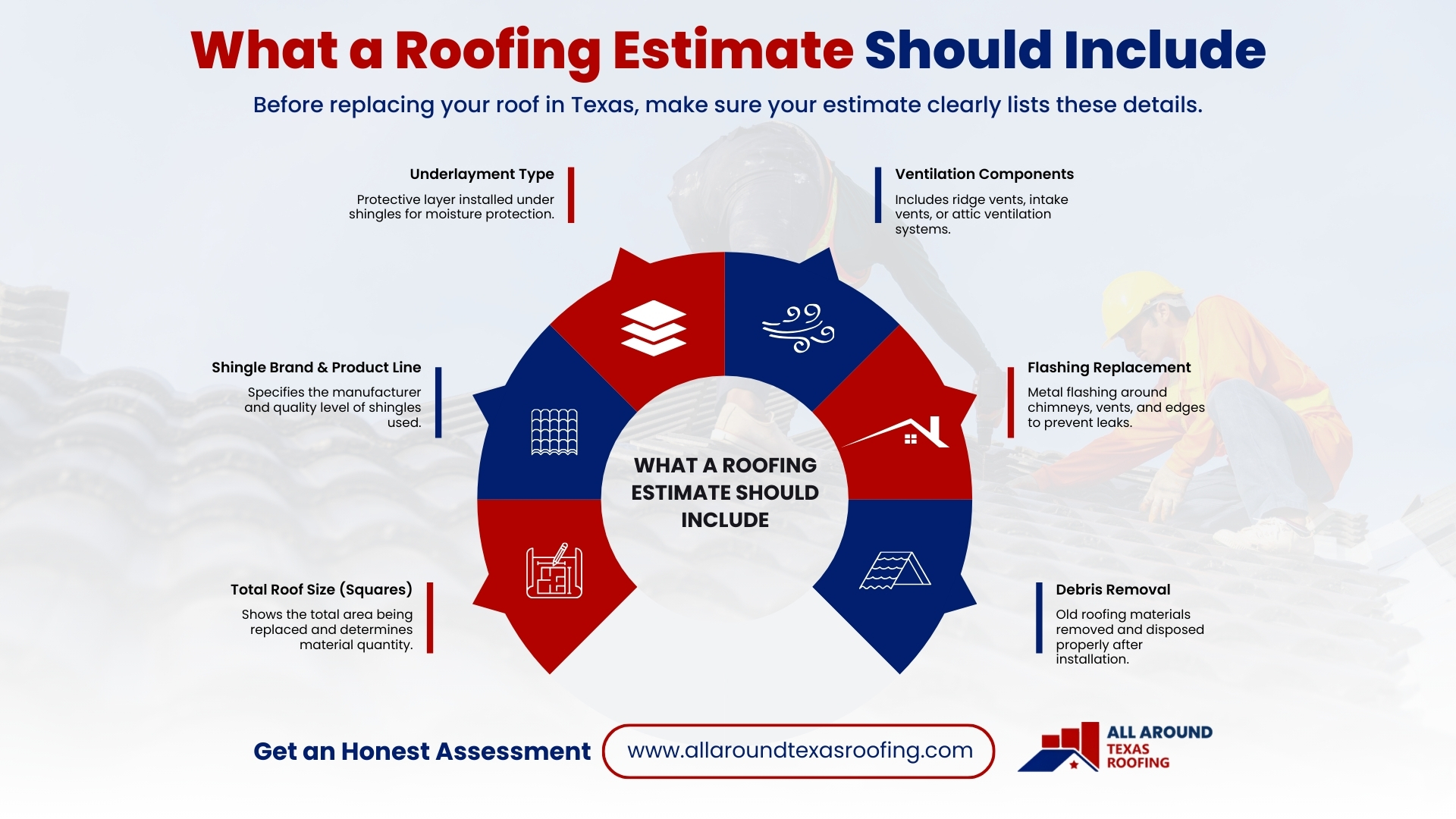
What a Roofing Estimate Should Include
When you receive a roof replacement estimate in Texas, it should clearly outline:
- Total roof size in squares
- Shingle brand and product line
- Underlayment type
- Ventilation components
- Flashing replacement details
- Cleanup and disposal
- Warranty information
If a bid seems unusually low, ask questions. Lower pricing sometimes reflects cheaper materials or minimal warranty coverage.
Financing Options for Roof Replacement
Not every roof replacement is covered by insurance.
Many roofing companies in DFW offer financing plans with monthly payment options. Terms vary, so it’s wise to review interest rates and timelines carefully.
Spreading payments over time can make a necessary replacement manageable without delaying repairs.
Planning vs. Waiting for Failure
Some homeowners wait until leaks appear. Others replace aging roofs before major damage occurs.
If your roof is 15 to 20 years old and you’re seeing granule loss, curling shingles, or repeated repairs, it may be time to request an inspection.
Catching issues early can prevent interior water damage, mold growth, and insulation problems.
The Real Bottom Line for Dallas Homeowners
So, how much does a new roof cost in Dallas in 2026?
For most homeowners, expect a realistic range between $12,000 and $18,000 for architectural shingles on a standard home. Smaller homes may fall closer to $8,000. Larger or premium material homes can exceed $25,000.
Your exact cost depends on size, materials, complexity, and whether insurance is involved.
A roof is not something you replace often. Taking time to understand your options, your policy, and your estimate helps you make a confident decision.
If you live in Prosper, Frisco, McKinney, Celina, Anna, Melissa, or elsewhere in North Texas, scheduling a professional inspection is the best first step. All Around Texas Roofing serves homeowners across the region and can provide a detailed evaluation tailored to your property.